Are Online Calculators Safe? How They Protect Your Privacy
Are Online Calculators Safe? How They Protect Your Privacy
Every time you enter your salary into a paycheck calculator, input your rent deposit into a lease converter, or type your revenue into a tax calculator, you are sharing personal financial information with a website. But where does that data actually go? Is someone collecting it?
This guide explains the two fundamentally different ways online calculators process your data and provides clear criteria for choosing tools that respect your privacy.
Server-Side vs Client-Side Calculation
Online calculators work in one of two ways, and the difference matters enormously for your privacy.
Server-Side Calculation
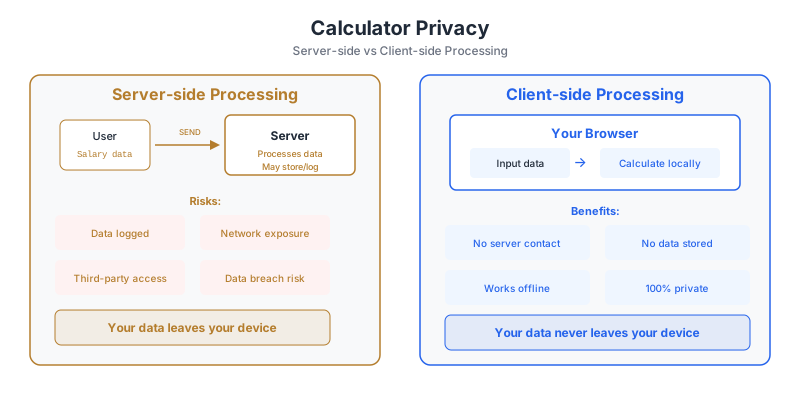
Your input travels across the internet to a remote server, which performs the calculation and sends the result back. In this model, the server operator has access to everything you typed. Your salary, deposit amount, or revenue figure could end up in server logs or databases.
Server-side processing is not inherently bad. Complex AI-driven analysis or large-scale data processing genuinely requires a server. But there is no reason to send simple arithmetic or tax calculations to a remote machine.
Client-Side Calculation
Your input stays inside your browser. The data never crosses the network. JavaScript running in your browser performs the calculation and displays the result on screen. When you close the tab, the data is gone.
Every calculator on utilo.kr uses this approach. Salary calculations, tax estimations, rent conversions, percentage calculations, date computations, and age calculations all happen entirely in your browser. Your input never reaches the server.
How to Verify This Yourself
Open your browser’s developer tools (F12) and switch to the Network tab. Enter values into a calculator and watch for outbound requests. If no data is sent to any server, the tool is using client-side calculation. Try this on utilo.kr — after the initial page load, you will see zero network requests no matter how many calculations you perform.
localStorage vs Cookies: How Data Gets Stored
Some websites save your input for convenience. Two technologies are commonly used, and they have very different privacy implications.
Cookies
Cookies are stored in your browser but are automatically sent to the server with every request. This means the server operator can read anything stored in a cookie. This is why cookies power ad tracking, behavioral analytics, and personalized advertising.
If a calculator stores your salary information in a cookie, that data can travel to the server on the next page load. Third-party cookies can even forward your data to advertising networks you have never heard of.
localStorage
localStorage lives exclusively in your browser and is never transmitted to any server. The data persists until you manually clear it, but it cannot leak to the outside world. Only the same browser on the same device can access it, making it suitable for remembering previous calculation inputs without compromising privacy.
utilo.kr does not use tracking cookies. When storing preferences or previous inputs, it uses localStorage only — your data never leaves your browser.
The Role of HTTPS
HTTPS encrypts the communication channel between your browser and the server. Even with server-side calculators, HTTPS prevents third parties from intercepting your data in transit.
However, HTTPS only protects data “in motion.” Once your data arrives at the server, what the operator does with it is entirely outside the scope of HTTPS. Seeing a padlock icon in your address bar does not mean your privacy is fully protected.
The safest combination is HTTPS plus client-side calculation. Your data never leaves the browser, and the page itself loads over an encrypted connection. utilo.kr uses this combination.
Why utilo.kr Does Not Collect Personal Data
utilo.kr is a pure utility site. There is no need to collect, analyze, or monetize financial data like salaries, deposits, or revenue figures. The business model does not depend on selling user data.
It is also technically impossible to collect this data. Since every calculation runs in the browser, the server has no knowledge of what values users enter. The server delivers HTML, CSS, and JavaScript files. Everything after that happens on the user’s device.
Five Criteria for Choosing Safe Online Tools
Before entering personal information into any online tool, check the following.
1. HTTPS Is Active
Look for the padlock icon in your address bar. Never enter sensitive information on a site that uses plain HTTP.
2. No Network Requests on Input
Open developer tools and confirm that typing values does not trigger server requests. If a simple calculator sends your input to a server, question why.
3. A Privacy Policy Exists
Read the site’s privacy policy to understand what data is collected and how it is used. Sites with no privacy policy at all should be avoided.
4. Minimal Third-Party Scripts
Sites loaded with advertising scripts, tracking pixels, and analytics tools carry a higher risk of your input being shared with third parties.
5. Open Source Code
If the source code is publicly available, you can verify exactly how your data is handled. This is the most reliable form of assurance.
Conclusion
The most important question when using an online calculator is: “Where does my data go?” With client-side tools, the answer is simple — nowhere.
Every tool on utilo.kr is designed to run entirely inside your browser. Whether you are calculating your take-home pay, converting between rent deposit types, or counting the days between two dates, the numbers exist only on your screen and vanish the moment you close the page. Use them with confidence.
Frequently Asked Questions
What standards do utilo calculators use?
Calculations reflect Korea's current laws, tax rates, and insurance premiums as published by official bodies (NTS, NPS, NHIS, BOK, etc.), updated when regulations change.
Is my input stored on the server?
No. All calculations run in your browser; inputs are never sent to or stored on our servers.
Can results differ from reality?
These tools provide general estimates and do not account for individual deductions, exemptions, or special conditions. For authoritative numbers, consult official sources or a professional.