Understanding Korea's 4 Major Insurance Deductions (2026)
Understanding Korea’s 4 Major Insurance Deductions (2026)
Every employee working in South Korea has four mandatory social insurance contributions deducted from their paycheck. Known collectively as the “4 major insurances” (4대보험), they consist of National Pension, Health Insurance (including Long-Term Care Insurance), Employment Insurance, and Industrial Accident Insurance. Since Industrial Accident Insurance is fully paid by the employer, it does not appear on your pay stub. This guide explains the three insurance types (four deduction items) that directly affect your take-home pay, using 2026 rates.
Overview of the 4 Major Insurances
The four major insurances are state-run social insurance programs where both employees and employers share the cost. Each program serves a distinct purpose and is managed by a different government agency.
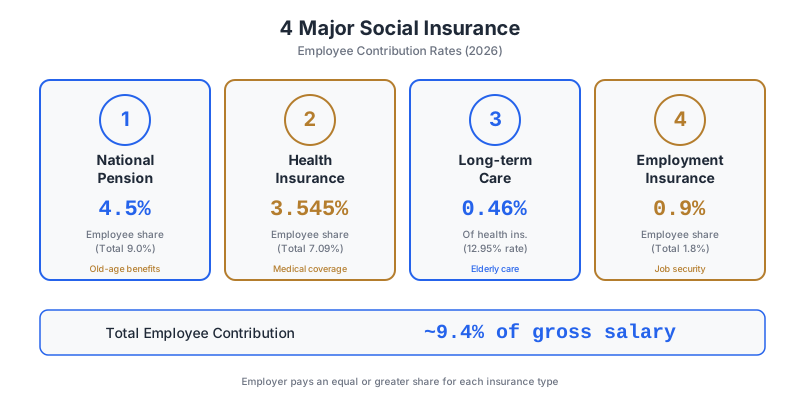
| Insurance Type | Managing Agency | Employee Share | Employer Share |
|---|---|---|---|
| National Pension | National Pension Service | 4.5% | 4.5% |
| Health Insurance | NHIS | 3.545% | 3.545% |
| Long-Term Care Insurance | NHIS | 12.95% of Health Ins. (half) | 12.95% of Health Ins. (half) |
| Employment Insurance | KCOMWEL | 0.9% | 0.9% + additional |
| Industrial Accident Ins. | KCOMWEL | None | Varies by industry |
National Pension: Mandatory Retirement Savings
Program Overview
The National Pension provides income replacement when a person’s earning capacity is reduced due to old age, disability, or death. All citizens between the ages of 18 and 60 are required to participate. Workplace subscribers are automatically enrolled when they start employment.
Contribution Rate and Calculation
The total National Pension contribution rate is 9% of the standard monthly income, split equally between employee and employer at 4.5% each.
The standard monthly income is your monthly earnings minus non-taxable income. Upper and lower limits are adjusted annually.
- Upper limit: Approximately 6.17 million KRW per month (2026 estimate)
- Lower limit: 390,000 KRW per month
Even if your monthly income exceeds the upper limit, contributions are capped at 6.17 million KRW, making the maximum monthly contribution about 277,650 KRW.
Eligibility for Benefits
To receive the old-age pension, you must have contributed for at least 10 years (120 months). The pension starting age ranges from 62 to 65, depending on your birth year.
Health Insurance: Reducing Medical Costs
Program Overview
Health Insurance reduces the financial burden of medical treatment for illness or injury. Enrollment is mandatory for all Korean residents. Employees are classified as workplace subscribers, and their premiums are calculated based on their monthly remuneration.
Contribution Rate and Calculation
The 2026 Health Insurance contribution rate is 7.09% of monthly remuneration, split equally at 3.545% each for employee and employer.
Monthly remuneration is your total compensation for the year divided by the number of months worked. Bonuses and performance pay are included.
Example (monthly salary of 3.5 million KRW):
- Health Insurance = 3,500,000 x 3.545% = 124,075 KRW
Additional Premiums on Non-Employment Income
If your annual income from sources other than employment (interest, dividends, rent, business income, etc.) exceeds 20 million KRW, an additional Health Insurance premium is levied on the excess. This is called the income-based premium.
Long-Term Care Insurance: Preparing for an Aging Society
Program Overview
Long-Term Care Insurance funds care services for individuals who, due to old age or age-related conditions such as dementia or stroke, have difficulty performing daily activities independently for six months or more. Introduced in July 2008, it automatically covers all Health Insurance subscribers.
Contribution Rate and Calculation
The Long-Term Care Insurance premium is calculated by multiplying your Health Insurance premium by the Long-Term Care rate. In 2026, this rate is 12.95% of the Health Insurance premium, shared equally between employee and employer.
Example (Health Insurance premium of 124,075 KRW):
- Long-Term Care premium = 124,075 x 12.95% = 16,068 KRW
- Employee share = 16,068 / 2 = 8,034 KRW
In practice, Health Insurance and Long-Term Care premiums are often combined on pay stubs.
Employment Insurance: Safety Net for Job Loss
Program Overview
Employment Insurance provides unemployment benefits (known as job-seeking allowance) to workers who lose their jobs, supports reemployment efforts, and promotes vocational skills development. It applies to all businesses employing one or more workers.
Contribution Rate and Calculation
Employment Insurance contributions are divided into unemployment benefits and employment stability/vocational training components.
Unemployment benefits portion:
- Employee share: 0.9%
- Employer share: 0.9%
Employment stability/vocational training (employer only):
- Fewer than 150 employees: 0.25%
- 150 to 999 employees: 0.45%–0.65%
- 1,000+ employees or government agencies: 0.85%
Employees only pay the unemployment benefits portion of 0.9%.
Example (monthly salary of 3.5 million KRW):
- Employment Insurance = 3,500,000 x 0.9% = 31,500 KRW
Eligibility for Job-Seeking Allowance
To qualify, you must have been insured for a combined total of at least 180 days during the 18 months before leaving your job. Only involuntary separations — such as dismissal, recommended resignation, or contract expiration — qualify for benefits.
Total Insurance Deduction Example
Here is a comprehensive breakdown for an employee earning 4 million KRW per month.
| Item | Rate | Monthly Deduction |
|---|---|---|
| National Pension | 4.5% | 180,000 KRW |
| Health Insurance | 3.545% | 141,800 KRW |
| Long-Term Care Insurance | Health Ins. x 12.95% / 2 | 9,187 KRW |
| Employment Insurance | 0.9% | 36,000 KRW |
| Total | 366,987 KRW |
On a monthly salary of 4 million KRW, social insurance deductions alone come to approximately 367,000 KRW. Income tax and local income tax are deducted on top of this.
Frequently Asked Questions
Q. Do the 4 major insurances apply during a probation period?
Yes. The four major insurances apply from your first day of employment, regardless of any probation period. An employer who delays enrollment during probation is violating the law.
Q. Do part-time workers need to enroll?
Workers who work 60 hours or more per month (15 hours or more per week) are required to enroll. Different rules may apply to daily wage earners.
Q. What happens to my insurance when I resign?
Your workplace subscriber status ends on your last day. For Health Insurance, you can switch to regional subscriber status or opt for voluntary continued coverage. National Pension contributions can be deferred, and Employment Insurance benefits can be claimed if eligible.
Calculate Your Exact Pay at utilo.kr
To see your full deduction breakdown — including all four major insurances plus taxes — in one place, try the salary calculator at utilo.kr/salary. Simply enter your annual salary to get an instant breakdown of each deduction and your final take-home pay.
Frequently Asked Questions
Why is take-home pay so much less than gross salary?
Deductions include National Pension (4.5%), Health Insurance (3.545%), Long-term Care (12.95% of health premium), Employment Insurance (0.9%) on the employee side, plus income tax and local income tax. The net-to-gross ratio is typically 75–88%.
Do insurance rates change each year?
National Pension has been fixed at 9.0% total (4.5% employee) since 1998, but Health Insurance and Long-term Care rates are announced around December and take effect the following January. This site updates figures at each change.
Can my actual payslip differ from the calculator result?
Yes. The calculator uses averages and doesn't account for non-taxable allowances, dependent deductions, year-end tax reconciliation, or company-specific benefits. Consult your HR team or payslip for exact figures.