Jeonse vs Wolse: Which Is Better Financially?
Jeonse vs Wolse: Which Is Better Financially?
When looking for a place to live in Korea, the first major decision renters face is choosing between jeonse and wolse. These two systems are the backbone of Korea’s rental housing market, and understanding the difference can save you millions of won. This guide breaks down both options, compares their costs, and explains how to decide which one fits your financial situation.
What Is Jeonse?
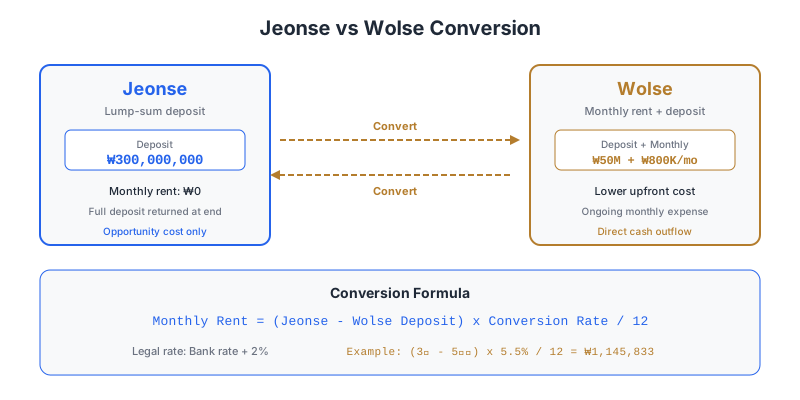
Jeonse (전세) is a rental system unique to South Korea. Instead of paying monthly rent, the tenant provides a large lump-sum deposit — typically 50% to 80% of the property’s market value — to the landlord at the start of the lease. The tenant then lives in the property rent-free for the contract period, usually two years. When the lease ends, the landlord returns the full deposit.
The system originated during Korea’s rapid economic growth period, when high interest rates meant landlords could earn substantial returns simply by investing or depositing the tenant’s money. The tenant benefited by avoiding monthly rent payments, making it a win-win arrangement under those conditions.
What Is Wolse?
Wolse (월세) is a conventional monthly rent system similar to what is found in most countries worldwide. The tenant pays a relatively small security deposit upfront and then makes fixed monthly rent payments throughout the lease. A typical wolse contract might look like 10 million won deposit with 500,000 won monthly rent.
In recent years, wolse has been gaining market share in Korea. Data from the Ministry of Land, Infrastructure, and Transport shows that new rental contracts with monthly rent components (including semi-jeonse) have been outnumbering pure jeonse contracts since the early 2020s, driven by low interest rates and growing concerns over deposit fraud.
Advantages and Disadvantages of Jeonse
Advantages
No monthly housing cost. Once the deposit is placed, there are no recurring rent payments. The tenant only needs to cover maintenance fees and utilities, making monthly budgeting simpler.
Deposit is fully refundable. In theory, the tenant pays zero net housing cost because the entire deposit is returned at the end of the lease. However, the opportunity cost of that money — what it could have earned if invested — should be factored in.
Tax deductions are available. Interest payments on jeonse loans qualify for income tax deductions, providing additional savings for salaried workers.
Disadvantages
Requires significant upfront capital. Deposits range from tens of millions to hundreds of millions of won, creating a high barrier to entry. Even with a jeonse loan, the borrower must pay interest, which becomes the de facto housing cost.
Risk of deposit non-return. High-profile jeonse fraud cases have made national headlines, highlighting the risk of landlords failing to return deposits. Jeonse deposit insurance is available but not always applicable to every property.
Sensitive to interest rate changes. If jeonse loan rates rise, the effective monthly cost increases substantially. Borrowers on variable-rate loans face especially sharp increases during tightening cycles.
Advantages and Disadvantages of Wolse
Advantages
Lower upfront capital required. The small deposit makes wolse accessible to young professionals, single-person households, and anyone without large savings.
Lower deposit loss risk. Because the deposit amount is much smaller, the financial exposure to non-return risk is proportionally lower.
Preserves liquidity. With less money locked up in a deposit, the tenant can invest or save the remainder. In a high-interest-rate environment, returns on liquid funds can partially offset monthly rent payments.
Disadvantages
Monthly payments are a sunk cost. Unlike a jeonse deposit that gets returned, monthly rent is spent and never recovered.
Higher cumulative cost over time. For longer tenancies, the total rent paid often exceeds what the tenant would have spent on jeonse loan interest for the same property.
How Interest Rates Change the Equation
The relative advantage of jeonse versus wolse shifts dramatically with the interest rate environment. The key concept here is the rent conversion rate (전월세전환율).
Low Interest Rate Environment (Base Rate Below 2%)
When rates are low, jeonse tends to be more advantageous. A jeonse loan at 3% annual interest on a 300 million won deposit translates to roughly 750,000 won per month in interest. However, converting the same deposit to wolse using a typical market conversion rate of 5–7% would result in monthly rent exceeding 1 million won.
High Interest Rate Environment (Base Rate Above 3%)
When rates climb, the calculus can flip. If jeonse loan rates reach 5–6%, monthly interest payments surge, while wolse conversion rates in the market do not rise as quickly. In this scenario, wolse may actually be cheaper.
The Legal Conversion Rate
Korea’s legally mandated rent conversion rate is set at the Bank of Korea base rate + 2.0% (as of 2024). This rate applies when converting between jeonse deposits and monthly rent. However, actual market conversion rates vary by region and property type, typically ranging from 4% to 8%.
Deciding What Is Right for You
There is no universally correct answer. The best choice depends on your personal financial circumstances.
Jeonse may be better if:
- You have the deposit funds available or can secure a low-interest loan
- You plan to stay for two or more years
- You want to minimize fixed monthly expenses
- The property qualifies for jeonse deposit insurance
Wolse may be better if:
- You lack sufficient upfront capital
- You plan a short-term stay of under one year
- You can invest your available funds at returns exceeding the rent cost
- You want to minimize exposure to deposit fraud risk
Calculate the Conversion Yourself
Comparing jeonse and wolse costs is not something you can do accurately by intuition alone. Multiple variables — conversion rate, loan interest rate, deposit size, and lease duration — must be weighed together.
The rent conversion calculator at utilo.kr/rent lets you freely convert between deposit and monthly rent amounts, instantly showing which option is more economical at current interest rates. It factors in both the legal conversion rate and typical market rates, making it a practical tool to use before signing any lease agreement.
There is no single right answer between jeonse and wolse. But making the decision based on actual numbers rather than guesswork will always lead to a better outcome.
Frequently Asked Questions
How is the jeonse-to-wolse conversion rate determined?
Under Korea's Housing Lease Protection Act, the rate is capped at the Bank of Korea base rate + 2% (currently around 5.5%). The Ministry of Land announces it annually. Contracts exceeding the cap may be voided.
Is jeonse always better than wolse?
It depends. Jeonse is favorable if you have liquid capital and no higher-return alternative. Wolse (monthly rent) can be better if your deposit can be invested for returns exceeding the conversion rate.
Should I take a jeonse loan or pay wolse?
Compare the loan rate to the statutory conversion rate. If the loan rate is lower, jeonse with financing wins on cash flow. If higher, wolse may be the better choice.