Korea's Age Reform: How to Calculate Your Age After the 2023 Law
Korea’s Age Reform: How to Calculate Your Age After the 2023 Law
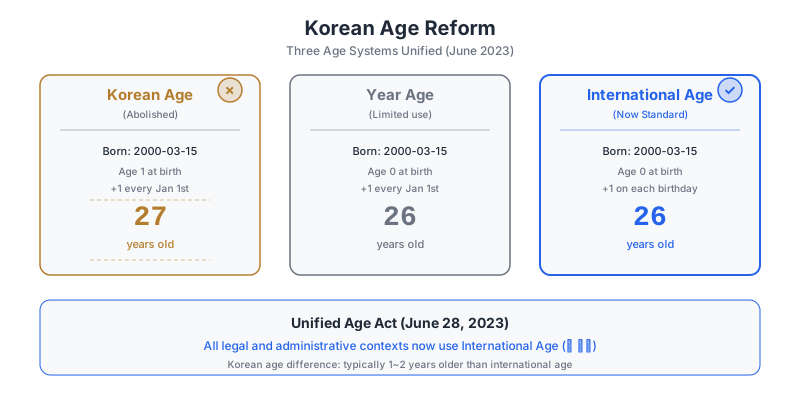
On June 28, 2023, South Korea implemented one of its most talked-about legal reforms in recent years. The country officially unified its age-counting system, abolishing the traditional “Korean age” and “year age” methods from all laws and official documents. Under the new system, only international age (만 나이) — the standard used in virtually every other country — is recognized. This guide explains the background of the reform, the differences between the three age systems, the real-world impact, and exactly how to calculate your age under the new law.
What Is the Age Unification Law?
The age unification law took effect on June 28, 2023, through amendments to the Framework Act on Administration (행정기본법) and the Civil Act (민법). The key provisions are:
- When age is stated in any law, regulation, or contract, it means international age unless explicitly specified otherwise.
- The character “세” (歲, meaning “years old”) is now interpreted as international age.
- Laws that previously used year-based age are now to be read as referring to international age.
As a result, international age became the default across resident registration records, administrative documents, and all legal instruments.
The Three Age Systems Explained
Korea has traditionally maintained three coexisting methods for counting age. Understanding their differences is essential for appreciating what the reform changed.
International Age (만 나이)
A person starts at age 0 on the day of birth and gains one year on each birthday. This is the global standard used in almost every country.
How to calculate:
- If this year’s birthday has passed: Current year - Birth year
- If this year’s birthday has not yet passed: Current year - Birth year - 1
Example: Born July 15, 1990, as of April 2025
- The 2025 birthday (July 15) has not passed yet: 2025 - 1990 - 1 = age 34
Korean Age (세는나이)
A person starts at age 1 on the day of birth, and everyone in the country adds one year simultaneously on January 1 each year. This traditional Korean system has been used in everyday conversation for centuries.
How to calculate:
- Korean age = Current year - Birth year + 1
Example: Born in 1990, as of 2025
- 2025 - 1990 + 1 = Korean age 36
Korean age is always 1 to 2 years more than international age. Before the birthday, the gap is 2 years; after the birthday, it is 1 year.
Year Age (연나이)
Calculated solely from the birth year, with no regard for the actual birthday. Everyone born in the same year is the same age throughout the calendar year.
How to calculate:
- Year age = Current year - Birth year
Example: Born in 1990, as of 2025
- 2025 - 1990 = year age 35
Year age was primarily used in certain Korean laws, including the Military Service Act (for conscription age) and the Juvenile Protection Act.
Comparison Table
Using the example of a person born July 15, 1990, compared at two points in 2025:
| Point in Time | International Age | Year Age | Korean Age |
|---|---|---|---|
| April 2025 (before birthday) | 34 | 35 | 36 |
| August 2025 (after birthday) | 35 | 35 | 36 |
The same person can have up to a 2-year difference depending on the counting method. Eliminating this confusion was the primary motivation for the reform.
Legal Impact and Everyday Changes
Alcohol and Tobacco Purchase Age
The legal age for purchasing alcohol and tobacco is 19 in international age. This was already the standard before the reform, so no practical change occurred. However, the reform clarified that retailers must verify international age specifically, ending any ambiguity from year-age-based practices.
Youth Protection Standards
Under the Juvenile Protection Act, a “juvenile” is defined as a person under age 19 in international age. While some provisions were previously interpreted using year age, the reform makes the international age standard explicit and unambiguous.
Military Service
The Military Service Act previously used year age for conscription eligibility. After the reform, the relevant provisions are interpreted using international age, though transitional measures were put in place so the change did not immediately disrupt existing conscription schedules.
Public Pension Eligibility
The starting age for receiving the National Pension, Government Employee Pension, and similar public pensions is now clearly defined in international age. If the pension eligibility age is 65, benefits begin after the person’s 65th birthday has passed.
Daily Conversation
While the law now mandates international age in all official contexts, the habit of using Korean age in casual conversation has been slow to change. When asked “How old are you?” in Korean, many people still respond with their Korean age. This is a deeply rooted cultural practice that cannot be altered by legislation alone.
However, as hospitals, government offices, and official documents exclusively use international age, the expectation is that everyday usage will gradually shift as well.
How to Calculate International Age Accurately
International age is determined by the birthday, so follow this procedure for an accurate result.
Step-by-Step
- Subtract the birth year from the current year.
- If this year’s birthday has not yet passed, subtract 1.
- If this year’s birthday has passed or today is the birthday, keep the result as is.
The Birthday Threshold
The exact moment a person’s international age increases is on the birthday itself. Under the Civil Act (Article 158), the day of birth is included in age calculations, which technically means the age changes at midnight (00:00) on the day before the birthday. In practice, however, the birthday itself is treated as the threshold date.
Special Case: Born on February 29
People born on February 29 during a leap year face a unique situation in non-leap years, when February 29 does not exist. Under Korean civil law (Article 161), their legal birthday in non-leap years is treated as March 1. This means their age remains unchanged through February 28 and increases on March 1 in non-leap years.
Quick Calculation Shortcut
To quickly determine international age from the current date:
- Compute current year - birth year.
- If today’s month and day are before the birthday’s month and day, subtract 1.
- If today’s date is on or after the birthday, keep the number.
Example: Today is April 15, 2025. Birth date is August 20, 1995.
- 2025 - 1995 = 30
- April 15 comes before August 20, so subtract 1 = international age 29
Check Your Age with a Calculator
While the arithmetic is simple, comparing international age alongside Korean age and year age, or checking your age at a specific past or future date, can be tedious to do manually.
The age calculator at utilo.kr/age lets you enter your date of birth and instantly see your international age, Korean age, and year age side by side. You can also set a custom reference date to check your age at any point in the past or future — useful for verifying pension eligibility dates, legal age thresholds, or historical age at a specific event.
Since the age unification law took effect, knowing your exact international age is no longer just a curiosity — it is a legal and administrative necessity. Take a moment to verify yours.
Frequently Asked Questions
What standards do utilo calculators use?
Calculations reflect Korea's current laws, tax rates, and insurance premiums as published by official bodies (NTS, NPS, NHIS, BOK, etc.), updated when regulations change.
Is my input stored on the server?
No. All calculations run in your browser; inputs are never sent to or stored on our servers.
Can results differ from reality?
These tools provide general estimates and do not account for individual deductions, exemptions, or special conditions. For authoritative numbers, consult official sources or a professional.