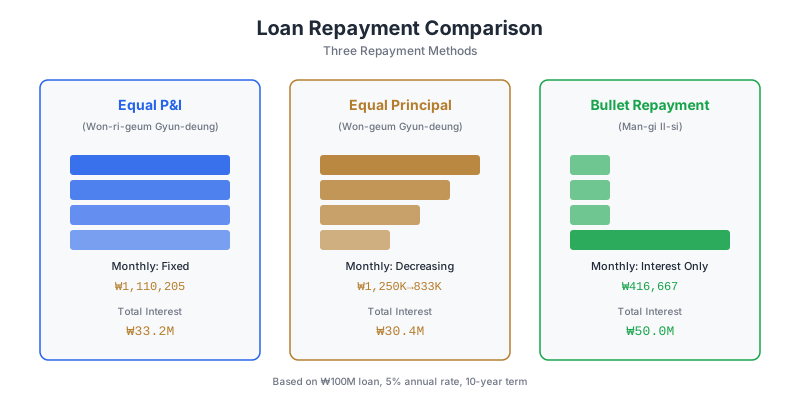
Loan Repayment Methods Compared: Equal P&I vs Equal Principal vs Bullet
Loan Repayment Methods Compared: Equal P&I vs Equal Principal vs Bullet
When taking out a loan, the repayment method you choose is just as important as the interest rate. With the same loan amount and rate, your monthly payment and total interest can vary dramatically depending on the repayment structure. This guide breaks down the three most common methods, compares them with real numbers, and helps you pick the best option for your situation.
Three Repayment Methods at a Glance
Equal Principal and Interest (Fully Amortizing)
With this method, you pay the same amount every month throughout the loan term. Inside each payment, the split between principal and interest changes over time. Early payments are mostly interest with little principal; later payments are mostly principal with little interest.
The monthly payment is calculated using the PMT formula:
Monthly Payment = Principal x r(1+r)^n / ((1+r)^n - 1)where r is the monthly interest rate and n is the number of months.
Equal Principal
With equal principal repayment, you repay the same amount of principal each month, plus interest on the remaining balance. Since the balance decreases every month, the interest portion shrinks, and your total monthly payment decreases over time.
Monthly Principal = Loan Amount / Number of Months
Monthly Interest = Remaining Balance x Monthly Rate
Monthly Payment = Monthly Principal + Monthly Interest
Bullet Repayment (Interest-Only)
Bullet repayment means you pay only interest each month and repay the entire principal at maturity. Because the principal never decreases, you pay the same interest every month until the final payment.
Monthly Interest = Loan Amount x Monthly Rate
Final Payment = Loan Amount + Monthly Interest
Side-by-Side Comparison
Let us compare all three methods for a 100 million KRW loan at 3.5% annual rate over 30 years (360 months).
| Equal P&I | Equal Principal | Bullet | |
|---|---|---|---|
| First month payment | ~449,000 | ~569,000 | ~292,000 |
| Last month payment | ~449,000 | ~279,000 | 100M + ~292,000 |
| Total interest | ~61.66M | ~52.64M | ~105M |
| Total repayment | ~161.66M | ~152.64M | ~205M |
The difference in total interest between equal principal and bullet repayment is staggering — over 50 million KRW for the same loan.
Pros and Cons
Equal P&I: Predictable but Costly
Pros:
- Fixed monthly payment makes budgeting straightforward
- Lower initial payments compared to equal principal
- The most commonly offered option by banks
Cons:
- Higher total interest than equal principal
- Principal balance decreases slowly in the early years
- You are effectively “renting” more of the bank’s money for longer
Equal Principal: Lowest Total Cost
Pros:
- Lowest total interest among amortizing methods
- Payments decrease over time, easing the burden as the loan matures
- Faster equity buildup for mortgages
Cons:
- Higher initial monthly payments
- May affect your debt-to-income ratio calculations unfavorably
- Not all lenders offer this option
Bullet: Lowest Monthly Burden
Pros:
- Minimal monthly cash outflow (interest only)
- Useful for short-term financing or bridge loans
- Can be advantageous if investment returns exceed the loan rate
Cons:
- Highest total interest by far
- Large lump-sum repayment at maturity
- Risky for long-term borrowing
When to Choose Each Method
Mortgages (Long-Term)
For a 20-30 year mortgage, equal principal saves the most money over the life of the loan. If the higher initial payments stretch your budget too thin, equal P&I with occasional prepayments is a practical alternative.
Jeonse Deposit Loans (2-4 Years)
In Korea, jeonse (lump-sum deposit) loans typically use bullet repayment since the borrower expects to recover the deposit at lease end to repay the principal.
Personal Loans (Short-Term)
For 1-3 year personal loans, equal P&I is standard. The short duration means the interest difference between methods is relatively small, so payment predictability matters more.
Business Loans
Startups and businesses often benefit from bullet repayment initially to preserve cash flow, then refinance into an amortizing structure once revenue stabilizes.
The Prepayment Strategy
If your loan allows fee-free prepayment (or has low prepayment penalties after an initial period), you can combine the best of both worlds: choose equal P&I for lower required monthly payments, then make extra principal payments whenever you have surplus cash. This approach achieves interest savings similar to equal principal without the mandatory high initial payments.
Calculate Your Own Scenario
The numbers above are illustrative. Your actual savings depend on your specific loan amount, rate, and term. Use the utilo.kr/loan calculator to compare all three methods side by side, view detailed monthly amortization schedules, and find the best repayment strategy for your situation.
A loan is one of the biggest financial commitments you will make. Taking the time to compare repayment methods can save you tens of millions of won over the life of the loan.
Frequently Asked Questions
Equal P&I vs Equal Principal — which saves more?
Equal Principal saves more total interest but has a heavier early-repayment burden. Equal P&I has fixed monthly payments, easier cash-flow management, and is the default for most Korean mortgages.
When are prepayment fees charged?
Typically within the first 3 years of the loan, at 0.5–2% of the remaining principal. After 3 years, prepayment fees are usually waived.
Variable vs fixed rate — which to choose?
Variable works when rates are falling; fixed is safer when rates are rising or you want predictable payments. Hybrid (fixed-then-variable) is another option available in Korea.