General vs Simplified Taxpayer: VAT Rate Differences in Korea
General vs Simplified Taxpayer: VAT Rate Differences in Korea
One of the first decisions you face when starting a business in Korea is choosing your tax classification. The Korean VAT system divides business operators into two categories: general taxpayers and simplified taxpayers. Each category comes with vastly different tax rates and filing requirements. This guide clearly explains the core differences between the two.
What Is a General Taxpayer?
A general taxpayer is a business operator subject to the standard 10% VAT rate under Korea’s Value-Added Tax Act. You are classified as a general taxpayer if your annual revenue is 80 million KRW or more, or if you operate in an industry excluded from simplified taxation (such as real estate leasing or taxable entertainment venues).
How General Taxpayers Calculate VAT
The VAT calculation for general taxpayers is straightforward:
VAT Payable = Output Tax - Input Tax
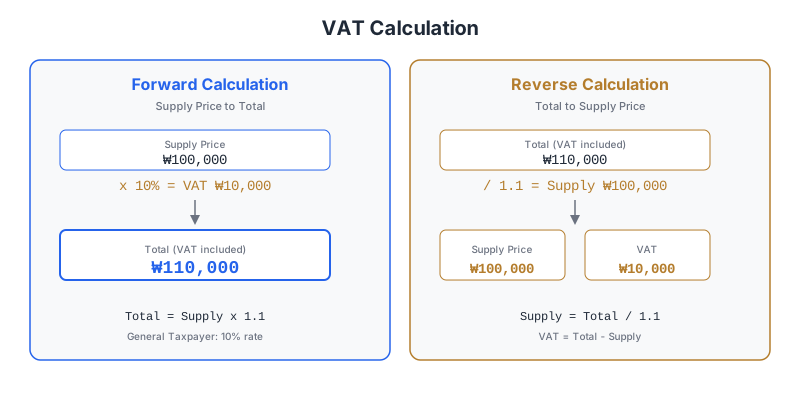
Output Tax = Supply Value × 10%
For example, if your quarterly revenue is 50 million KRW and purchases are 30 million KRW:
- Output tax = 50M × 10% = 5 million KRW
- Input tax = 30M × 10% = 3 million KRW
- VAT payable = 5M - 3M = 2 million KRW
Advantages of General Taxpayer Status
- Full input tax credit: You can deduct the full VAT paid on business-related purchases.
- Tax invoice issuance: You can issue tax invoices, which is essential for B2B transactions.
- Refund eligibility: If input tax exceeds output tax (common during initial investment or for exporters), you can receive a VAT refund.
Disadvantages of General Taxpayer Status
- Higher tax burden: VAT obligations can be significantly larger than for simplified taxpayers.
- Filing frequency: You must file confirmed returns twice a year (January and July) and preliminary returns twice a year (April and October).
- Bookkeeping requirements: You must maintain double-entry bookkeeping or simplified ledgers.
What Is a Simplified Taxpayer?
A simplified taxpayer is a small-scale business operator whose previous year’s revenue was less than 80 million KRW. Simplified taxpayers enjoy lower effective tax rates and streamlined filing procedures.
How Simplified Taxpayers Calculate VAT
Simplified taxpayers calculate VAT using an industry-specific value-added ratio:
VAT = Revenue × Industry Value-Added Ratio × 10%The 2026 industry value-added ratios are:
| Industry | Value-Added Ratio | Effective Tax Rate |
|---|---|---|
| Retail, recycled material collection & sales | 15% | 1.5% |
| Manufacturing, agriculture, forestry, fishing, utilities | 20% | 2.0% |
| Food & beverage services (restaurants) | 25% | 2.5% |
| Construction, transportation, storage, IT | 30% | 3.0% |
| Financial & insurance services, professional & technical services | 40% | 4.0% |
| Real estate leasing, other services | 40% | 4.0% |
For example, a restaurant with annual revenue of 60 million KRW:
- VAT = 60M × 25% × 10% = 1.5 million KRW
A general taxpayer with the same revenue would typically pay considerably more, depending on input tax credits.
Input Tax Credit for Simplified Taxpayers
Simplified taxpayers can claim input tax credits, but the amount is limited to purchase amount × industry value-added ratio × 0.5%. This is substantially less generous than the full credit available to general taxpayers.
Payment Exemption for Small Simplified Taxpayers
Simplified taxpayers with annual revenue below 48 million KRW are exempt from VAT payment. However, they must still file a return. Input tax credits do not apply even if tax invoices were received.
Side-by-Side Comparison
| Category | General Taxpayer | Simplified Taxpayer |
|---|---|---|
| Revenue threshold | 80M KRW or more | Less than 80M KRW |
| Tax rate | 10% | 1.5–4% (by industry) |
| Input tax credit | Full credit | Limited credit |
| Tax invoice issuance | Yes | Yes, if revenue ≥ 48M KRW |
| Filing frequency | Twice per year | Once per year (January) |
| Refund eligibility | Yes | No |
| Payment exemption | No | Revenue < 48M KRW |
Important Considerations When Switching
Simplified to General Taxpayer
If your previous year’s revenue exceeds 80 million KRW, you are automatically reclassified as a general taxpayer starting July 1 of the following year. Key points to note:
- Inventory tax credit: You can claim input tax credits on inventory purchased during the simplified taxpayer period.
- Tax invoice obligation: You must issue tax invoices for all taxable transactions after conversion.
- Bookkeeping requirements: Double-entry or simplified bookkeeping obligations begin.
General to Simplified Taxpayer
If your revenue drops below 80 million KRW, you may convert to simplified status. However, simplified taxation does not apply in certain cases:
- Industries excluded from simplified taxation (mining, real estate trading, etc.)
- Businesses operating in excluded zones
- Operators with multiple business locations whose combined revenue exceeds 80 million KRW
Voluntary General Taxpayer Election
Even if you qualify as a simplified taxpayer, you can voluntarily elect general taxpayer status. This is advantageous when you have significant B2B transactions or need refunds on large initial investments. Simply submit a general taxpayer application to your local tax office.
Which Type Is Better for You?
Simplified Taxpayer Is Better When:
- Your business serves individual consumers (B2C)
- You operate a service business with low purchase ratios
- Your revenue is expected to stay below 80 million KRW
- You want to minimize tax administration burden
General Taxpayer Is Better When:
- You have many B2B transactions
- You run a manufacturing or wholesale business with high purchase ratios
- Your initial equipment investment is large (to utilize refunds)
- You export goods (zero-rate VAT enables refunds)
Calculate Your VAT at utilo.kr
If VAT calculations feel complicated, try the calculator at utilo.kr/tax. Simply enter the supply value or total amount, and it will compute the VAT automatically. It is a practical tool for both general and simplified taxpayers.
Conclusion
Choosing between general and simplified taxpayer status is not just about the tax rate. You need to weigh input tax credits, tax invoice requirements, refund eligibility, and administrative overhead. Even if you start as a simplified taxpayer, growing revenue will eventually trigger an automatic conversion to general status, so understanding both systems from the outset is essential.
Frequently Asked Questions
What's the difference between general and simplified taxpayers in Korea?
General taxpayers charge 10% VAT and can claim input VAT credits. Simplified taxpayers face lower industry-specific rates (0.5–3%) but have limited credit claims. From 2024, businesses with annual revenue under KRW 104M qualify for simplified status.
Is VAT ultimately borne by the consumer?
Yes. Businesses remit the difference between output and input VAT, but the economic burden passes to the final consumer — VAT is an indirect tax.
Zero-rated vs tax-exempt — what's the difference?
Zero-rated supplies (e.g., exports) are VAT-taxable at 0%, allowing input VAT credits. Tax-exempt supplies (certain essentials) are outside the VAT system, so no input VAT credit is available.