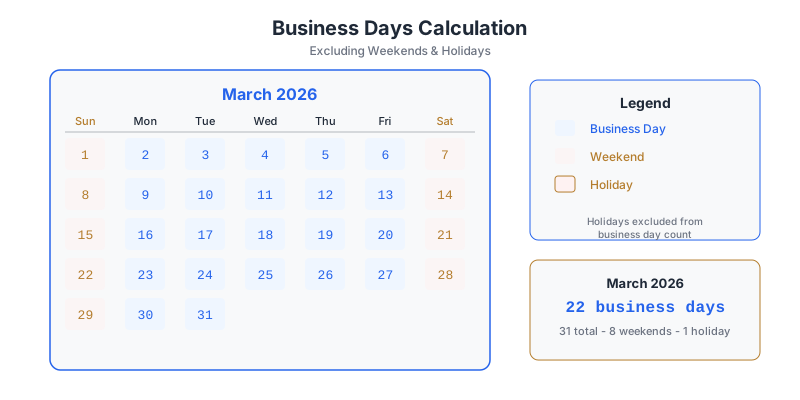
How to Calculate Business Days (Excluding Weekends & Holidays)
How to Calculate Business Days (Excluding Weekends & Holidays)
“Your request will be processed within 5 business days.” Whether dealing with government offices, banks, shipping, or refund processing, the term “business days” comes up constantly. Yet many people are unsure exactly what counts as a business day and how to calculate them correctly. This guide covers the precise definition, Korea’s public holiday calendar, step-by-step calculation methods, and the most common mistakes.
What Is a Business Day?
A business day is any day on which an institution or company conducts normal operations. Generally, this means weekdays (Monday through Friday) excluding Saturdays, Sundays, and legally designated public holidays.
However, the exact definition can vary by context:
- Financial institutions: Days excluding weekends, public holidays, and Workers’ Day (May 1). Bank business days are governed by the Bank of Korea Act.
- Government offices: Days excluding weekends and holidays as specified in the Government Office Holiday Regulations.
- Private companies: Varies by company policy — some include Saturdays as working days.
- Legal contexts: Periods expressed in “days” (일) typically mean calendar days, while “business days” (영업일) explicitly exclude non-working days.
Korean Public Holidays
Accurate business day calculations require knowing Korea’s official public holidays. As of 2024, the list includes:
| Date | Holiday | Notes |
|---|---|---|
| January 1 | New Year’s Day | Solar calendar |
| Lunar Dec 30 – Jan 2 | Seollal (Lunar New Year) | 3-day holiday |
| March 1 | Independence Movement Day | |
| May 5 | Children’s Day | |
| Lunar April 8 | Buddha’s Birthday | Solar date varies annually |
| June 6 | Memorial Day | |
| August 15 | Liberation Day | |
| Lunar Aug 14–16 | Chuseok | 3-day holiday |
| October 3 | National Foundation Day | |
| October 9 | Hangul Day | |
| December 25 | Christmas |
Substitute Holidays
Since 2014, Korea’s substitute holiday system designates the next available weekday as a holiday when Seollal, Chuseok, or Children’s Day falls on a weekend or overlaps with another public holiday. Starting in 2021, Liberation Day, National Foundation Day, and Hangul Day were also made eligible for substitute holidays.
These substitute holidays must be treated as non-business days in calculations, so it is worth checking the substitute holiday schedule at the beginning of each year.
Workers’ Day (May 1)
Workers’ Day is not a public holiday under law but is a paid day off under the Labor Standards Act. Banks and securities firms close, but government offices remain open. Whether May 1 counts as a business day depends on which institution you are dealing with.
How to Calculate Business Days
Basic Procedure
-
Determine the start date. In most cases, the start date is not included in the count. For example, “within 3 business days from the date of submission” means counting begins on the next business day after submission.
-
Count forward, skipping non-business days. Move through the calendar day by day, skipping Saturdays, Sundays, and public holidays, and count only weekdays.
-
Check for substitute and ad-hoc holidays. Verify whether any substitute holidays or government-designated temporary holidays fall within the period.
Calculation Examples
Example 1: Document Processing Time
A document is submitted on Wednesday, April 30, 2025, with a “5 business day” processing guarantee.
- April 30 (Wed): Submission date (not counted)
- May 1 (Thu): Workers’ Day — government offices open, banks closed
- May 2 (Fri): Business day 1
- May 3 (Sat): Weekend
- May 4 (Sun): Weekend
- May 5 (Mon): Children’s Day (public holiday)
- May 6 (Tue): Possible substitute holiday — verify for the specific year
- May 7 (Wed): Business day 2 or 3 depending on May 6 status
- Counting continues until business day 5 is reached
If the institution is a government office where May 1 is a working day, the count starts from May 1, reaching 5 business days sooner. The result can differ by one or more days depending on the institution type.
Example 2: Shipping Estimate
“2–3 business days for delivery” on an order placed Friday evening:
- Friday: Order date (not counted — after business hours)
- Saturday/Sunday: Weekend
- Monday: Business day 1
- Tuesday: Business day 2
- Wednesday: Business day 3
Delivery can be expected between Monday and Wednesday. A Friday evening order effectively adds a weekend delay, making the perceived wait longer than orders placed early in the week.
Common Mistakes in Business Day Calculations
Confusion About Whether the Start Date Is Included
When someone says “3 business days from today,” whether “today” is included depends on context. In legal period calculations, the start date is generally excluded (Civil Code Article 157), but in everyday usage, it is sometimes included. For important deadlines, always clarify the starting point explicitly.
Forgetting Substitute Holidays
Substitute holiday dates change every year, so relying on past experience alone can lead to errors. Seollal and Chuseok are based on the lunar calendar, meaning their solar calendar dates shift annually — making this especially error-prone.
Ignoring Institution-Specific Differences
As explained above, Workers’ Day and certain industry-specific closures vary by institution. When told something will take “X business days,” the first step to an accurate calculation is confirming whose business days are being referenced.
Use a Business Day Calculator
Manually counting business days while accounting for public holidays, substitute holidays, and weekends is tedious — especially for longer periods like 20 or 30 business days.
The date calculator at utilo.kr/date automatically calculates the number of business days between two dates or finds the date that falls N business days from a given start date. Korean public holidays are built in, so you get accurate results without having to look up the holiday schedule yourself.
Whether you need to determine a document processing deadline, an estimated delivery date, or a contract performance date, this tool handles the calculation instantly.
Frequently Asked Questions
What standards do utilo calculators use?
Calculations reflect Korea's current laws, tax rates, and insurance premiums as published by official bodies (NTS, NPS, NHIS, BOK, etc.), updated when regulations change.
Is my input stored on the server?
No. All calculations run in your browser; inputs are never sent to or stored on our servers.
Can results differ from reality?
These tools provide general estimates and do not account for individual deductions, exemptions, or special conditions. For authoritative numbers, consult official sources or a professional.