D-Day Calculator: How to Count Days Between Two Dates
D-Day Calculator: How to Count Days Between Two Dates
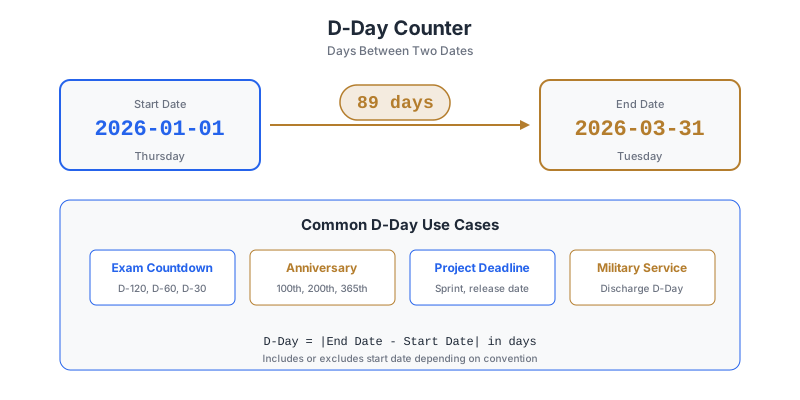
“D-30 until the exam.” “D-100 until discharge.” “D+365 since we started dating.” In Korea, D-Day counting is woven into everyday life. Whether you are tracking how many days remain until a goal, how many have passed since an event, or simply the gap between two dates, the concept seems straightforward — but it has surprising room for confusion. This guide covers the precise meaning of D-Day, practical use cases, and the correct way to calculate the number of days between any two dates.
What Does D-Day Mean?
D-Day originally comes from military terminology, referring to the day a particular operation is set to begin. The most famous example is the Normandy landings on June 6, 1944, during World War II. The “D” simply stands for “Day” — making D-Day literally “the day.”
In Korean culture, the term has been adopted for everyday use. It serves as a countdown to a target date in the future or a count-up from a reference date in the past.
D-Day Notation
- D-Day (D-0): The reference date itself
- D-30: 30 days remaining until D-Day (future)
- D+100: 100 days have passed since D-Day (past reference)
An important nuance: whether the D-Day date itself is included in the count can cause a one-day discrepancy. If today is D-Day, it is D-0. But when someone says “30 days until the exam,” including today yields D-30, while excluding today yields D-29.
Real-World D-Day Use Cases
Military Service
For Korean men, the most familiar D-Day application is the military discharge countdown. Soldiers count the total days from enlistment to discharge and track the shrinking number daily. For an 18-month Army service (approximately 548 days), the enlistment date is set as D-548 and the discharge date as D-Day. “D-100 celebrations” are a genuine tradition in Korean military life.
Exam Preparation
Students preparing for the CSAT (수능), civil service exams, or professional certifications use D-Day calculations as the foundation of their study plans. Knowing the exact number of days remaining allows precise allocation of study time across subjects, scheduling of practice tests, and planning of final review periods.
For example, if the CSAT falls on the third Thursday of November and it is currently April, the roughly 200 remaining days can be divided across Korean, math, English, and elective subjects.
Anniversaries
Celebrating the 100th day, 200th day, and first anniversary of a relationship is deeply ingrained in Korean dating culture. A common point of confusion is exactly when the “100th day” falls.
If the first day of the relationship is counted as day 1, the 100th day is the start date plus 99 calendar days. If counted as day 0, the 100th day is the start date plus 100 calendar days. In standard Korean practice, the starting day is counted as day 1. So if a relationship begins on January 1, the 100th day is April 10.
Pregnancy and Due Dates
In pregnancy tracking, D-Day is the estimated due date. The standard calculation places the due date 280 days (40 weeks) after the first day of the last menstrual period. Expectant parents use this date to schedule checkups, prepare for delivery, and plan parental leave.
Project Deadlines
In the workplace, D-Day tracking applies to project deadlines, delivery dates, and contract expiration dates. For large projects with multiple milestones, teams often set D-Day markers for each phase to monitor progress.
How to Count Days Between Two Dates
The Basic Principle
The number of days between two dates is simply the end date minus the start date.
Days = End date - Start dateFor example, from January 1, 2025 to March 1, 2025:
- January: 31 days
- February: 28 days (2025 is not a leap year)
- Total: 31 + 28 = 59 days
This calculation excludes the start date and includes the end date. To include both endpoints, add 1.
Watch for Leap Years
When the calculation spans February, check whether the year is a leap year. Leap years follow these rules:
- Years divisible by 4 are leap years
- Exception: years divisible by 100 are not leap years
- Exception to the exception: years divisible by 400 are leap years
So 2024 is a leap year (February has 29 days), 2025 is not (February has 28 days), 2000 was a leap year, and 1900 was not. Missing a leap year in a multi-year calculation creates a one-day error.
Month Length Variations
Because months have different lengths, “one month later” does not always mean the same number of days.
| Month | Days |
|---|---|
| Jan, Mar, May, Jul, Aug, Oct, Dec | 31 |
| Apr, Jun, Sep, Nov | 30 |
| Feb | 28 (29 in leap years) |
When calculating “3 months from now,” use the actual day counts of the specific months involved rather than assuming a flat 90 days.
Converting to Weeks
To express a day count in weeks:
Weeks = Days ÷ 7
Remainder = Days % 7
Example: 100 days = 14 weeks and 2 days.
Tips for Manual Calculation
When working with a calendar on paper, these tips help reduce errors:
- Same month: Simple subtraction. March 5 to March 20 = 20 - 5 = 15 days.
- Crossing months: Break into segments and add. March 20 to May 10 = (31 - 20) + 30 + 10 = 51 days.
- Crossing years: Calculate start date to December 31, then January 1 to end date, and sum.
- Decide on start date inclusion first: Before calculating, determine whether the start date is included. Settling this upfront prevents confusion throughout the calculation.
Use the D-Day Calculator
Short spans of a few days can be counted on a calendar by hand, but for periods of hundreds of days or spans that include leap years, manual calculation is tedious and error-prone.
The date calculator at utilo.kr/date instantly shows the exact number of days between any two dates. Select a start and end date, and you get the total day count, week-and-day breakdown, and business day count all at once. It also offers an option to include or exclude the start date, ensuring an accurate D-Day count for your specific situation.
Whether it is a military discharge date, an exam date, a relationship anniversary, or a project deadline, use the calculator whenever D-Day accuracy matters.
Frequently Asked Questions
What standards do utilo calculators use?
Calculations reflect Korea's current laws, tax rates, and insurance premiums as published by official bodies (NTS, NPS, NHIS, BOK, etc.), updated when regulations change.
Is my input stored on the server?
No. All calculations run in your browser; inputs are never sent to or stored on our servers.
Can results differ from reality?
These tools provide general estimates and do not account for individual deductions, exemptions, or special conditions. For authoritative numbers, consult official sources or a professional.