Net Pay Comparison Table: 30M to 100M KRW Salary
Net Pay Comparison Table: 30M to 100M KRW Salary
When someone asks “what is your salary?”, the answer is almost always the gross (pre-tax) figure. But what truly matters for day-to-day life is the net amount deposited into your bank account each month. This guide compares net pay across major salary brackets from 30 million to 100 million KRW and explains why the deduction rate climbs steeply as income grows.
Net Pay Comparison Table (2026 Estimates)
The table below assumes one dependent (the employee only), with 200,000 KRW per month in non-taxable meal allowance. Actual amounts may vary depending on number of dependents, non-taxable items, and prior-year income.
| Annual Salary | Monthly Gross | Insurance Deductions | Income Tax + Local Tax | Monthly Net | Annual Net | Net Ratio |
|---|---|---|---|---|---|---|
| 30M KRW | 2,500,000 | ~236,000 | ~31,000 | ~2,233,000 | ~26,796,000 | 89.3% |
| 35M KRW | 2,916,667 | ~275,000 | ~52,000 | ~2,589,667 | ~31,076,000 | 88.8% |
| 40M KRW | 3,333,333 | ~315,000 | ~83,000 | ~2,935,333 | ~35,224,000 | 88.1% |
| 45M KRW | 3,750,000 | ~354,000 | ~115,000 | ~3,281,000 | ~39,372,000 | 87.5% |
| 50M KRW | 4,166,667 | ~393,000 | ~163,000 | ~3,610,667 | ~43,328,000 | 86.7% |
| 55M KRW | 4,583,333 | ~432,000 | ~216,000 | ~3,935,333 | ~47,224,000 | 85.9% |
| 60M KRW | 5,000,000 | ~472,000 | ~280,000 | ~4,248,000 | ~50,976,000 | 85.0% |
| 70M KRW | 5,833,333 | ~540,000 | ~437,000 | ~4,856,333 | ~58,276,000 | 83.3% |
| 80M KRW | 6,666,667 | ~580,000 | ~618,000 | ~5,468,667 | ~65,624,000 | 82.0% |
| 90M KRW | 7,500,000 | ~612,000 | ~837,000 | ~6,051,000 | ~72,612,000 | 80.7% |
| 100M KRW | 8,333,333 | ~645,000 | ~1,088,000 | ~6,600,333 | ~79,204,000 | 79.2% |
Analyzing the Deduction Structure
Social Insurance Is Proportional but Capped
National Pension contributions are capped at a standard monthly income of approximately 6.17 million KRW, so the pension premium stays flat beyond a certain salary level. Health Insurance and Employment Insurance continue to scale with income. As a result, the effective insurance burden as a percentage of salary actually decreases slightly at higher income levels.
For example, social insurance takes about 9.4% of a 30M KRW salary but only about 7.7% of a 100M KRW salary, thanks to the pension cap.
Progressive Income Tax Is the Key Driver
The biggest factor behind the shrinking net-to-gross ratio is the progressive income tax structure. Korea applies rates from 6% to 45% across taxable income brackets.
| Taxable Income | Rate | Progressive Deduction |
|---|---|---|
| Up to 14M KRW | 6% | — |
| 14M–50M KRW | 15% | 1.26M KRW |
| 50M–88M KRW | 24% | 5.76M KRW |
| 88M–150M KRW | 35% | 15.44M KRW |
At a 30M KRW salary, most taxable income falls within the 6–15% brackets. At 100M KRW, the 24–35% brackets come into play. This is the core reason why the net ratio drops sharply for higher earners.
The Local Income Tax Amplifier
Local income tax equals 10% of income tax, effectively adding a 10% surcharge on your income tax bill. As income tax grows, local income tax scales proportionally.
Key Insights by Salary Bracket
30–40 Million KRW
This range covers many entry-level and early-career employees. The net ratio remains relatively high at 88–89%, and income tax is modest. Non-taxable items such as meal and transportation allowances have a proportionally larger impact on take-home pay in this bracket.
50–60 Million KRW
These salaries exceed the Korean average and fall squarely in the 15% income tax bracket. The net ratio is 85–87%, with monthly take-home pay around 3.6 to 4.25 million KRW. Year-end tax settlement deductions start to become more meaningful at this level.
70–80 Million KRW
The 24% bracket begins to apply, and deductions increase noticeably. The net ratio drops to 82–83%, with monthly net pay between roughly 4.86 and 5.47 million KRW. The pre-tax difference between 70M and 80M KRW is about 833,000 KRW per month, but the after-tax difference is only about 612,000 KRW.
90–100 Million KRW
At these levels, the 35% bracket applies to a larger share of income. The net ratio falls to 79–81%. A 100M KRW salary translates to roughly 6.6 million KRW per month in net pay — about 1.73 million KRW less than the gross monthly figure of 8.33 million KRW.
The Real Impact of a Salary Raise
Understanding how much of a raise you actually keep is essential. Here is what happens when you add 10 million KRW to your annual salary.
| Raise Range | Monthly Gross Increase | Monthly Net Increase | Marginal Deduction Rate |
|---|---|---|---|
| 30M → 40M KRW | 833,333 | ~702,000 | 15.7% |
| 40M → 50M KRW | 833,333 | ~676,000 | 18.9% |
| 50M → 60M KRW | 833,333 | ~637,000 | 23.5% |
| 70M → 80M KRW | 833,333 | ~612,000 | 26.6% |
| 90M → 100M KRW | 833,333 | ~549,000 | 34.1% |
A 10M KRW raise from 30M to 40M results in a marginal deduction rate of 15.7%, meaning you keep about 84% of the raise. The same raise from 90M to 100M carries a marginal deduction rate of 34.1%, so you keep only about 66%.
Check Your Exact Net Pay
The figures above are estimates based on standard assumptions. Your actual net pay depends on your specific situation — number of dependents, non-taxable income items, additional allowances, and more. Use the calculator at utilo.kr/salary to enter your personal details and get a precise breakdown.
Conclusion
The most important takeaway from this comparison is that the marginal deduction rate increases sharply with income, a natural consequence of progressive taxation. When negotiating salary, compare offers on a net-pay basis rather than just looking at gross figures. Also consider non-taxable benefits, welfare packages, and bonus structures — all of which can meaningfully boost your actual take-home income.
Frequently Asked Questions
Why is take-home pay so much less than gross salary?
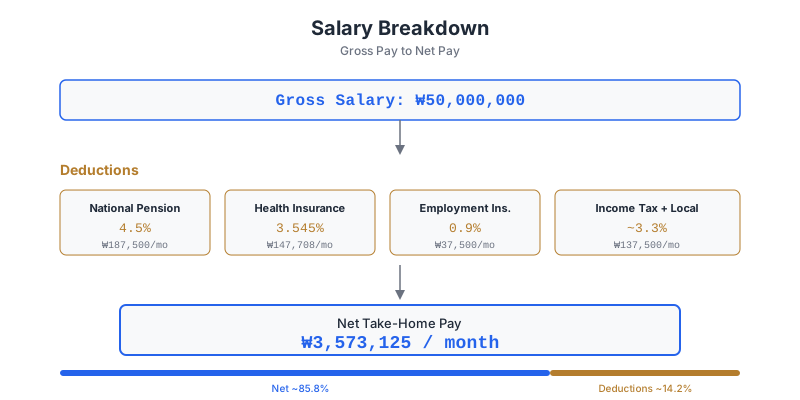
Deductions include National Pension (4.5%), Health Insurance (3.545%), Long-term Care (12.95% of health premium), Employment Insurance (0.9%) on the employee side, plus income tax and local income tax. The net-to-gross ratio is typically 75–88%.
Do insurance rates change each year?
National Pension has been fixed at 9.0% total (4.5% employee) since 1998, but Health Insurance and Long-term Care rates are announced around December and take effect the following January. This site updates figures at each change.
Can my actual payslip differ from the calculator result?
Yes. The calculator uses averages and doesn't account for non-taxable allowances, dependent deductions, year-end tax reconciliation, or company-specific benefits. Consult your HR team or payslip for exact figures.