Complete Guide to Severance Pay Calculation in Korea
Complete Guide to Severance Pay Calculation in Korea
Severance pay (퇴직금) is a legally mandated lump-sum payment that Korean employers must provide to employees who have worked continuously for one year or more. Governed by the Labor Standards Act and the Employee Retirement Benefit Guarantee Act, it applies to all workplaces regardless of size. This guide covers everything from eligibility requirements to the exact calculation process.
Eligibility Requirements
To qualify for severance pay, an employee must meet these conditions:
- Continuous service of 1 year or more: The period from the hire date to the resignation/termination date must be at least one year.
- At least 15 hours per week: The employee must have worked an average of 15 or more hours per week over a 4-week period.
- All worker types qualify: Full-time, contract, and part-time workers are all eligible as long as they meet the above conditions.
Even if an employee has worked less than one year, some companies may still pay severance based on internal policies or employment contracts, though it is not legally required.
The Severance Pay Formula
The formula itself is straightforward:
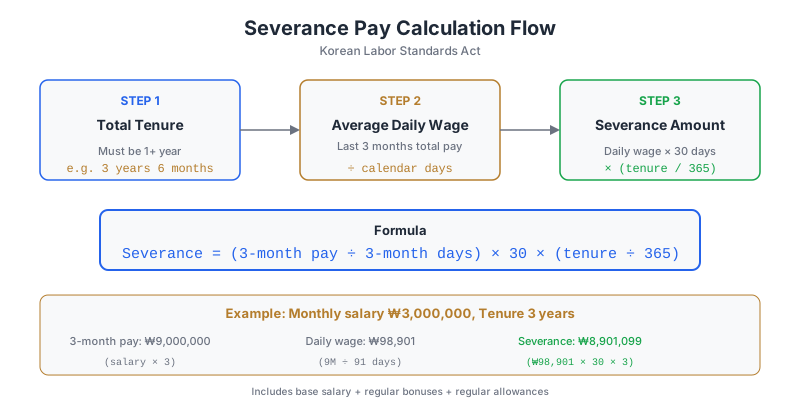
Severance Pay = Daily Average Wage x 30 x (Total Days of Service / 365)
The critical factor is accurately calculating the Daily Average Wage.
Calculating the Daily Average Wage
The daily average wage is determined by dividing the total wages paid during the 3 months prior to the date of resignation by the total number of calendar days in that period.
Daily Average Wage = Total Wages for Last 3 Months / Calendar Days in That Period
What Counts as Wages
- Base salary
- Fixed allowances (position allowance, certification allowance, seniority pay, etc.)
- Regular bonuses (prorated to the 3-month period)
- Unused annual leave allowance
What Does Not Count
- Payments made after resignation
- One-time payments (congratulatory/condolence money)
- Expense reimbursements (travel, transportation)
- Welfare benefits (holiday gifts, etc.)
The 3-Month Period
The standard calculation uses 91 days for the 3-month period. However, the actual number of calendar days in the relevant months may vary. For example, January + February + March = 90 days (or 91 in a leap year).
Practical Examples
Example 1: Same Salary, 3 Years of Service
- Start date: January 1, 2022
- End date: January 1, 2025 (1,096 days including leap year 2024)
- Monthly salary for last 3 months: 3,000,000 KRW each
Calculation:
- Total wages for 3 months = 3,000,000 x 3 = 9,000,000 KRW
- Daily average wage = 9,000,000 / 91 = 98,901 KRW
- Severance pay = 98,901 x 30 x (1,096 / 365) = 8,907,747 KRW
This is approximately 3 times the monthly salary, consistent with the rule of thumb that severance equals roughly one month’s pay per year of service.
Example 2: Varying Salary
- Start date: July 1, 2023
- End date: July 1, 2025 (731 days)
- Last 3 months’ salaries: 3,500,000 / 3,200,000 / 3,000,000 KRW
Calculation:
- Total wages = 3,500,000 + 3,200,000 + 3,000,000 = 9,700,000 KRW
- Daily average wage = 9,700,000 / 91 = 106,593 KRW
- Severance pay = 106,593 x 30 x (731 / 365) = 6,403,671 KRW
Ordinary Wage Comparison
If the calculated daily average wage is lower than the ordinary wage, the ordinary wage must be used instead. Ordinary wage refers to wages that are regularly, uniformly, and fixedly paid for contracted work hours.
Daily Ordinary Wage = Monthly Ordinary Wage / 209 hours x 8 hours
(209 hours is the standard monthly working hours based on a 40-hour work week.)
Interim Settlement of Severance
Since July 26, 2012, interim settlement of severance pay is generally prohibited. However, exceptions include:
- Purchase of a home by a non-homeowner
- Medical treatment of 6 months or more for the employee, spouse, or dependents
- Bankruptcy or personal rehabilitation proceedings within 5 years
- Natural disasters or other reasons designated by the Minister of Employment and Labor
When interim settlement occurs, severance for the period up to that point is paid out, and future severance is calculated from the settlement date onward.
Payment Deadline
Employers must pay severance within 14 days of the employee’s resignation date. If special circumstances exist, the deadline may be extended by mutual agreement. Late payment incurs interest at an annual rate of 20%.
Severance vs. Retirement Pension
Many Korean companies have transitioned to retirement pension plans:
- DB (Defined Benefit): The employer guarantees a severance amount calculated using the same formula. The employee benefits from higher pay at the time of retirement.
- DC (Defined Contribution): The employer contributes at least 1/12 of annual salary each year. The final amount depends on investment returns.
Both types are subject to the same retirement income tax framework.
Conclusion
Severance pay is a fundamental right of Korean workers. Use utilo.kr’s Severance Pay Calculator to quickly determine your severance by entering your start date, end date, and recent 3-month salary. If you are approaching retirement or resignation, calculating your expected severance in advance will help you plan your finances effectively.
Frequently Asked Questions
Who qualifies for severance pay in Korea?
Any employee who has worked 15+ hours/week for 1+ year continuously (full-time, contract, or daily). Voluntary resignation is eligible, though unemployment benefits have separate criteria.
How much is severance income tax?
Effective rates are very low thanks to the service-year deduction (KRW 1.5M/year) and the 'annualized conversion' method. Longer tenure means lower tax — typically 1–5% effective rate.
Pension (DB/DC) vs lump-sum severance?
Lump-sum severance is paid once at exit. Pension contributions are deposited periodically into a provider-managed account in the employee's name — DC is self-directed, DB is company-managed.