Severance Pay Tax Guide: Calculation and Savings Strategies
Severance Pay Tax Guide: Calculation and Savings Strategies
When you receive severance pay in Korea, you are subject to retirement income tax (퇴직소득세). Unlike regular earned income, retirement income is accumulated over a long period, so the tax system applies a special method called the annualization and multiplication method (연분연승법) to reduce the tax burden. This guide explains the entire calculation process and practical ways to minimize your taxes legally.
What Is Retirement Income Tax?
Retirement income tax is a form of income tax levied on severance pay and retirement benefits. Because severance is income earned over multiple years, taxing it as a single year’s income would result in an unfairly high tax rate. The annualization method addresses this by effectively spreading the income across the years of service, applying the tax rate, and then scaling back up.
The 6-Step Calculation Process
Step 1: Determine Retirement Income Amount
Subtract non-taxable retirement income from the total severance payment.
Retirement Income = Severance Payment - Non-taxable Retirement Income
In most cases, there are no non-taxable items, so the full severance amount is taxed.
Step 2: Retirement Income Deduction
A deduction based on years of service is applied:
| Years of Service | Deduction Amount |
|---|---|
| Up to 5 years | Years x 1,000,000 KRW |
| 5-10 years | 5,000,000 + (Years - 5) x 2,000,000 KRW |
| 10-20 years | 15,000,000 + (Years - 10) x 2,500,000 KRW |
| Over 20 years | 40,000,000 + (Years - 20) x 3,000,000 KRW |
Step 3: Calculate Converted Income
Converted Income = (Retirement Income - Retirement Deduction) x 12 / Years of Service
This is the core of the annualization method. The longer the service period, the greater the division effect, resulting in lower taxes.
Step 4: Converted Income Deduction
An additional deduction is applied to the converted income:
| Converted Income | Deduction |
|---|---|
| Up to 8,000,000 | Full amount |
| 8M - 70M | 8,000,000 + excess x 60% |
| 70M - 100M | 45,200,000 + excess x 55% |
| 100M - 300M | 61,700,000 + excess x 45% |
| Over 300M | 151,700,000 + excess x 35% |
Step 5: Converted Tax Amount
Apply the standard income tax rates (6% to 45%) to the taxable base (converted income minus converted income deduction).
Step 6: Final Retirement Income Tax
Retirement Income Tax = Converted Tax Amount x Years of Service / 12
Add local income tax (10% of the retirement income tax) to get the total tax payable.
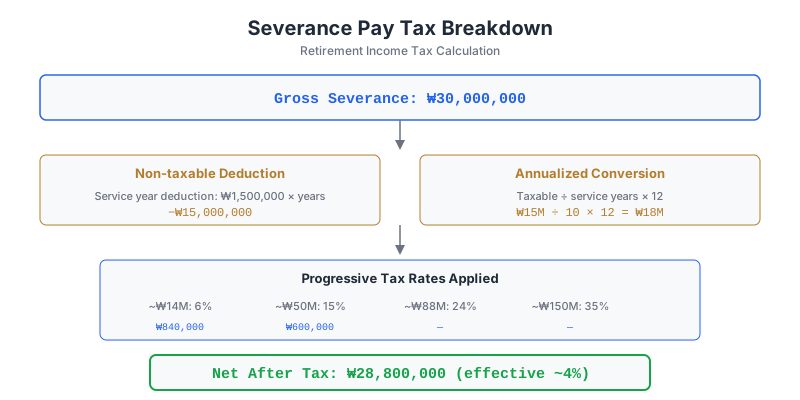
Worked Example
Conditions:
- Severance pay: 30,000,000 KRW
- Years of service: 10 years
Calculation:
- Retirement income: 30,000,000 KRW
- Retirement deduction: 5,000,000 + (10-5) x 2,000,000 = 15,000,000 KRW
- Converted income: (30,000,000 - 15,000,000) x 12/10 = 18,000,000 KRW
- Converted income deduction: 8,000,000 + (18,000,000 - 8,000,000) x 60% = 14,000,000 KRW
- Taxable base: 18,000,000 - 14,000,000 = 4,000,000 KRW
- Converted tax: 4,000,000 x 6% = 240,000 KRW
- Retirement income tax: 240,000 x 10/12 = 200,000 KRW
- Local income tax: 20,000 KRW
- Total tax: 220,000 KRW (effective rate: approximately 0.7%)
As this example shows, the effective tax rate on severance pay is remarkably low thanks to the annualization method.
Tax Savings Strategies
1. Transfer to an IRP (Individual Retirement Pension)
The most effective strategy. When you transfer your severance to an IRP account, the retirement income tax is deferred. When you later receive it as a pension (annuity), only 60-70% of the original retirement income tax is charged as pension income tax.
- Pension after age 55: Tax = 70% of retirement income tax (30% savings)
- Pension period exceeding 10 years: Tax = 60% of retirement income tax (40% savings)
2. Stay Within Annual Pension Limits
When receiving pension payments, if you exceed the annual limit, the excess is taxed as other income at 16.5%. Staying within the limit ensures only the lower pension income tax rate applies.
Annual Pension Limit = Remaining Retirement Benefit Balance / (11 - Pension Receiving Year)
3. Maximize Years of Service
Due to the annualization method, longer service results in lower taxes. If you can time your departure, staying until your service years increase by one more year can meaningfully reduce your tax bill.
4. Minimize Interim Settlements
Interim settlement resets your years of service, reducing the progressive deduction benefit on future severance. Unless absolutely necessary, it is more tax-efficient to avoid interim settlements and use alternatives like IRP contributions.
DC (Defined Contribution) Plans
For employees enrolled in DC retirement pension plans, the employer contributes at least 1/12 of annual salary each year. Upon retirement, the total accumulated amount plus investment returns constitutes the retirement benefit. The same retirement income tax calculation applies, but investment gains are also subject to retirement income tax.
DB (Defined Benefit) vs. DC Comparison
DB plans calculate severance using the standard formula, making them advantageous when your final salary is high. DC plans depend on investment performance, so returns can be higher or lower. From a tax perspective, both follow the same retirement income tax framework.
Key Tax Rates at a Glance
For reference, here is the impact of service length on effective tax rates for a 30,000,000 KRW severance:
| Years of Service | Approx. Effective Rate |
|---|---|
| 3 years | ~2.5% |
| 5 years | ~1.5% |
| 10 years | ~0.7% |
| 20 years | ~0.3% |
| 30 years | ~0.1% |
The longer you work, the lower the effective rate becomes.
Conclusion
While Korean severance pay benefits from a favorable tax structure, additional savings are possible through IRP accounts and careful pension planning. Before retiring, use utilo.kr’s Severance Pay Calculator to estimate your severance amount, then consult with a tax professional to determine the optimal receiving strategy for your situation.
Frequently Asked Questions
Who qualifies for severance pay in Korea?
Any employee who has worked 15+ hours/week for 1+ year continuously (full-time, contract, or daily). Voluntary resignation is eligible, though unemployment benefits have separate criteria.
How much is severance income tax?
Effective rates are very low thanks to the service-year deduction (KRW 1.5M/year) and the 'annualized conversion' method. Longer tenure means lower tax — typically 1–5% effective rate.
Pension (DB/DC) vs lump-sum severance?
Lump-sum severance is paid once at exit. Pension contributions are deposited periodically into a provider-managed account in the employee's name — DC is self-directed, DB is company-managed.