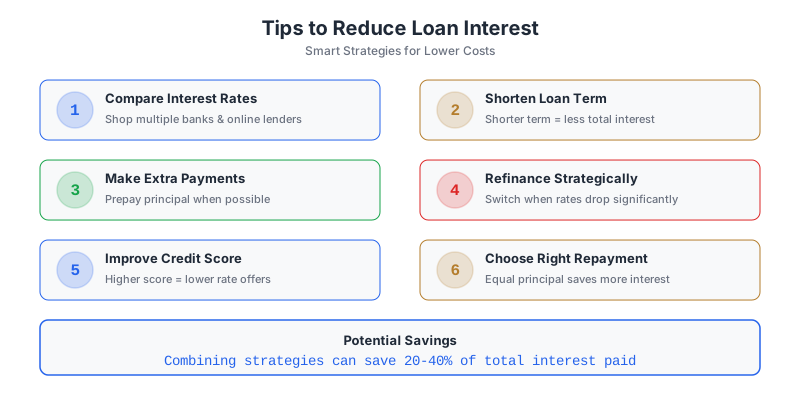
5 Ways to Reduce Your Loan Interest
5 Ways to Reduce Your Loan Interest
A 0.5 percentage point difference in your loan rate can add up to millions of won in extra interest over a 30-year mortgage. Even if you have already taken out a loan, active management can significantly reduce your interest burden. Here are five actionable strategies with concrete numbers to help you pay less.
1. Compare Rates Across Multiple Lenders
Even for the same type of loan, rates can vary significantly between lenders. Checking major banks, internet-only banks, insurance companies, credit unions, and community banks should be your first step.
How to Compare Effectively
- Banking association rate comparison services let you view rates from all financial institutions side by side.
- Fintech comparison platforms like KakaoBank and Toss can show you personalized rates based on your credit profile instantly.
- Online vs. in-branch: Internet banks and non-face-to-face channels often offer rates 0.1 to 0.3 percentage points lower than branch-originated loans.
The Real Impact of Rate Differences
For a 100 million KRW loan over 30 years with equal P&I repayment:
| Rate | Monthly Payment | Total Interest | vs. 3.0% |
|---|---|---|---|
| 3.0% | ~422,000 | ~51.78M | - |
| 3.5% | ~449,000 | ~61.66M | +9.88M |
| 4.0% | ~477,000 | ~71.87M | +20.09M |
| 4.5% | ~507,000 | ~82.40M | +30.62M |
A 1 percentage point difference produces roughly 20 million KRW in additional interest over 30 years.
2. Make Prepayments Whenever Possible
Every time you make an extra principal payment, you reduce the balance on which future interest is calculated. This creates a compounding savings effect that grows over time.
Prepayment Considerations
- Prepayment penalties: Most Korean loans charge 0.7 to 1.5% of the prepaid amount within the first 3 years. After 3 years, penalties are typically waived.
- Minimum amounts: Some banks require a minimum prepayment of 1 million KRW.
- Term reduction vs. payment reduction: When you prepay, you can usually choose to shorten the loan term or reduce your monthly payment. Shortening the term saves more interest overall.
Prepayment Example
On a 100 million KRW, 3.5%, 30-year equal P&I loan, making a 10 million KRW prepayment in year 5:
- Term reduction: approximately 4 years and 4 months shorter, saving about 11 million KRW in interest
- Payment reduction: approximately 45,000 KRW lower monthly payment, saving about 5.8 million KRW in interest
3. Switch to Equal Principal Repayment
If you currently have an equal P&I loan, switching to equal principal repayment reduces your total interest because principal is repaid faster.
For a 100 million KRW loan at 3.5% over 30 years:
| Method | Total Interest | Difference |
|---|---|---|
| Equal P&I | ~61.66M | - |
| Equal Principal | ~52.64M | -9.02M |
That is roughly 9 million KRW in savings. Note that the switch requires a request to your bank, and some may charge a processing fee.
4. Refinance to a Lower Rate
If market rates have dropped since you took out your loan, or if your credit score has improved, refinancing — taking a new loan to pay off the old one — could save you significantly.
Refinancing Checklist
- Rate gap: You generally need at least a 0.3 to 0.5 percentage point reduction to offset refinancing costs (prepayment penalties, origination fees, mortgage registration fees).
- Remaining term: The longer your remaining term, the greater the potential savings. If you have less than 5 years left, refinancing may not be worthwhile.
- Total cost calculation: Add up the old loan’s prepayment penalty, the new loan’s origination fee, and any mortgage registration costs. Subtract this from the projected interest savings to find your net benefit.
- Fixed vs. variable: In a rising rate environment, locking in a fixed rate protects you. In a falling rate environment, a variable rate may save more.
Refinancing Example
Remaining balance of 80 million KRW, 25 years left, refinancing from 4.5% to 3.5%:
- Monthly payment drops from about 405,000 KRW to about 359,000 KRW (roughly 46,000 KRW savings)
- Total interest savings over the remaining term: approximately 13.8 million KRW
- Even after deducting refinancing costs, the net savings remain substantial
5. Maximize Preferential Rate Discounts
Most banks offer a menu of preferential rate conditions. Each individual discount is small — typically 0.1 to 0.3 percentage points — but stacking several can lower your rate by 0.5 to 1.0 percentage points.
Common Discount Categories
- Salary transfer: Direct depositing your salary to the lending bank typically earns 0.1 to 0.3 percentage points off
- Auto-payment registration: Setting up automatic bill payments can earn 0.1 percentage points
- Savings account: Opening a savings product with the bank often provides 0.1 to 0.2 percentage points
- Credit card usage: Meeting a monthly spending threshold on the bank’s credit card can earn 0.1 percentage points
- Mobile banking enrollment: Simply registering for mobile banking may provide 0.1 percentage points
- Green housing: Purchasing an energy-efficient home can earn 0.1 to 0.2 percentage points at select banks
Maintaining Your Discounts
Preferential rates are reviewed periodically. If you stop your salary transfer or fall below the credit card spending threshold, the discount can be revoked. Set reminders to ensure you maintain all qualifying conditions.
Action Plan Summary
- Audit your current loan: Note your rate, balance, remaining term, repayment method, and prepayment penalty terms
- Compare rates: Check current offerings from other lenders to evaluate refinancing potential
- Review discount conditions: Activate every preferential rate discount available to you
- Consider repayment method change: Ask your bank about switching to equal principal
- Plan prepayments: Allocate surplus funds to principal reduction whenever possible
Calculate Your Savings
The impact of each strategy depends on your specific loan terms. Use the utilo.kr/loan calculator to model different amounts, rates, terms, and repayment methods. The detailed monthly amortization schedule makes it easy to see exactly how much each change saves you.
Loan interest is not fixed — it is manageable. Small rate differences compound into large sums over time. Regular review of your loan terms is one of the simplest and most impactful financial habits you can develop.
Frequently Asked Questions
Equal P&I vs Equal Principal — which saves more?
Equal Principal saves more total interest but has a heavier early-repayment burden. Equal P&I has fixed monthly payments, easier cash-flow management, and is the default for most Korean mortgages.
When are prepayment fees charged?
Typically within the first 3 years of the loan, at 0.5–2% of the remaining principal. After 3 years, prepayment fees are usually waived.
Variable vs fixed rate — which to choose?
Variable works when rates are falling; fixed is safer when rates are rising or you want predictable payments. Hybrid (fixed-then-variable) is another option available in Korea.