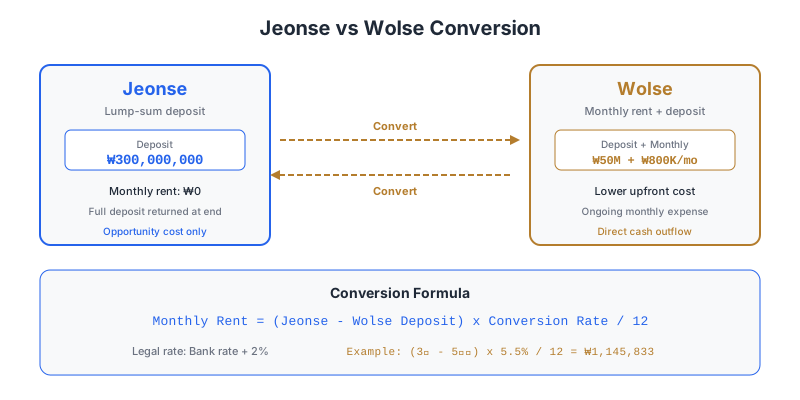
How to Convert Jeonse Deposit to Monthly Rent
How to Convert Jeonse Deposit to Monthly Rent
Converting a jeonse (lump-sum deposit) lease to wolse (monthly rent), or adjusting the balance between deposit and rent in a so-called “semi-jeonse” arrangement, is one of the most common transactions in Korea’s rental housing market. The key concept behind every such conversion is the rent conversion rate (전월세전환율). This guide explains the rate in detail, walks through the legal formula, and provides worked examples you can apply to your own situation.
What Is the Rent Conversion Rate?
The rent conversion rate is the annualized percentage used to translate a deposit amount into an equivalent monthly rent amount, and vice versa. Think of it as the implied annual return that a landlord expects from the deposit money.
For example, if the conversion rate is 6% and the deposit is reduced by 100 million won, the corresponding annual rent is 100 million × 6% = 6 million won, or 500,000 won per month. The higher the conversion rate, the more monthly rent the tenant pays for the same deposit reduction — so a lower rate favors the tenant.
The Legal Conversion Rate
Under the Housing Lease Protection Act (주택임대차보호법), there is a legal cap on the conversion rate that landlords can apply when converting an existing jeonse contract to monthly rent:
Legal conversion rate cap = Bank of Korea base rate + 2.0%
As of 2024, with the BOK base rate at 3.5%, the legal cap is 5.5%. This means a landlord cannot apply a conversion rate exceeding 5.5% when transforming an existing jeonse lease into wolse.
Important caveats: this rule applies only to conversions of existing jeonse contracts, not to new wolse contracts negotiated from scratch. Actual market conversion rates can be higher or lower than the legal cap. If a landlord applies a rate exceeding the legal maximum, the tenant has the right to claim a refund of the excess amount.
The Conversion Formula
Jeonse to Wolse
To convert all or part of a jeonse deposit into monthly rent:
Monthly rent = (Deposit amount to convert × Conversion rate) ÷ 12The “deposit amount to convert” is the portion of the deposit being reduced. If converting a pure jeonse into wolse entirely, it equals the total jeonse deposit minus the new wolse security deposit.
Wolse to Jeonse
To convert monthly rent into an equivalent deposit:
Equivalent deposit = (Monthly rent × 12) ÷ Conversion rateWorked Examples
Example 1: Jeonse to Semi-Jeonse
A tenant currently has a 300 million won jeonse lease. The landlord proposes reducing the deposit to 200 million won and converting the difference to monthly rent. Using the legal cap of 5.5%:
Amount to convert = 300M - 200M = 100 million won
Monthly rent = (100,000,000 × 5.5%) ÷ 12 = 5,500,000 ÷ 12 ≈ 458,333 won
The new lease terms would be approximately 200 million won deposit with 458,000 won monthly rent.
Example 2: Wolse to Pure Jeonse
A tenant currently pays 20 million won deposit and 800,000 won monthly rent. They want to convert to pure jeonse. Using a 5.5% conversion rate:
Equivalent deposit = (800,000 × 12) ÷ 5.5% = 9,600,000 ÷ 0.055 ≈ 174,545,000 won
Total jeonse deposit = 20,000,000 + 174,545,000 ≈ 194,500,000 won
The pure jeonse deposit would be approximately 194.5 million won.
Example 3: Impact of Different Conversion Rates
Converting 100 million won of deposit to monthly rent at various rates:
| Conversion Rate | Annual Rent Total | Monthly Rent |
|---|---|---|
| 4.0% | 4,000,000 won | ~333,000 won |
| 5.5% | 5,500,000 won | ~458,000 won |
| 7.0% | 7,000,000 won | ~583,000 won |
| 8.0% | 8,000,000 won | ~667,000 won |
A single percentage point difference in the conversion rate has a significant impact on monthly payments. This is why verifying the applied rate is critical during any conversion negotiation.
Key Considerations When Converting
Verify Legal Compliance
When converting an existing jeonse contract, confirm that the landlord’s proposed conversion rate does not exceed the legal cap. If it does, the tenant can legally demand a reduction or claim a refund of the excess rent paid.
Understand Market Rate Variations
Actual market conversion rates vary significantly by location and property type. In Seoul’s Gangnam district, rates tend to run 3–5%, while smaller cities outside the capital area may see rates of 7–10%. If the market rate is lower than the legal cap, the tenant should negotiate based on the market rate.
Compare Against Loan Interest Rates
The simplest way to determine whether jeonse or wolse is more economical is to compare the jeonse loan interest rate against the conversion rate. If jeonse loan rate < conversion rate, jeonse is cheaper. If the loan rate exceeds the conversion rate, wolse is more cost-effective.
For instance, if a jeonse loan charges 4% annual interest but the conversion rate is 6%, then on the same deposit amount, the jeonse loan interest is lower than the equivalent wolse — making jeonse the better deal.
Account for Tax Benefits
Jeonse loan interest payments qualify for income tax deductions (up to 4 million won annually on principal and interest repayment). Monthly rent qualifies for a tax credit (17% of up to 7.5 million won annually, approximately 1.27 million won maximum). Depending on your income bracket and deduction limits, one option may offer greater tax savings.
Try the Conversion Calculator
While the formula itself is straightforward, comparing multiple scenarios that factor in deposit size, conversion rate, loan interest, and tax benefits can become tedious to do by hand.
The rent conversion calculator at utilo.kr/rent lets you input deposit and rent amounts, adjust the conversion rate, and instantly compare different scenarios. It supports both the legal conversion rate and custom rates, making it a practical tool for real-world lease negotiations.
Converting between jeonse and wolse is not just arithmetic — it is a personal financial strategy decision. Getting the numbers right is the first step toward making the best choice.
Frequently Asked Questions
How is the jeonse-to-wolse conversion rate determined?
Under Korea's Housing Lease Protection Act, the rate is capped at the Bank of Korea base rate + 2% (currently around 5.5%). The Ministry of Land announces it annually. Contracts exceeding the cap may be voided.
Is jeonse always better than wolse?
It depends. Jeonse is favorable if you have liquid capital and no higher-return alternative. Wolse (monthly rent) can be better if your deposit can be invested for returns exceeding the conversion rate.
Should I take a jeonse loan or pay wolse?
Compare the loan rate to the statutory conversion rate. If the loan rate is lower, jeonse with financing wins on cash flow. If higher, wolse may be the better choice.