Complete Guide to Calculating Net Pay in Korea (2026)
Complete Guide to Calculating Net Pay in Korea (2026)
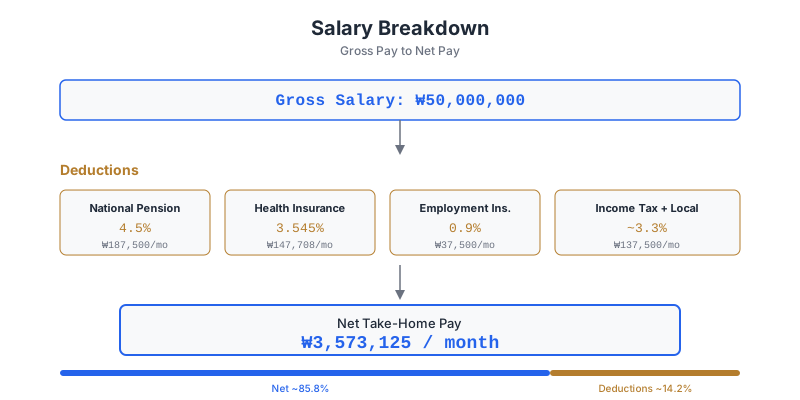
When starting a new job or negotiating a raise in South Korea, the annual salary figure your employer offers can be misleading. The gap between your gross salary and the amount that actually lands in your bank account is significant. National Pension, Health Insurance, Employment Insurance, income tax, and local income tax are all deducted before you receive your paycheck. This guide walks you through each deduction and shows you exactly how to calculate your net pay for 2026.
Gross Salary vs. Net Pay
Your gross salary (before tax) is the total annual compensation your employer agrees to pay you. It may include base pay and various allowances. Net pay (after tax) is the amount you actually receive after all mandatory deductions have been subtracted.
In general, the net-to-gross ratio for Korean employees ranges from about 75% to 88%. Because income tax uses a progressive rate structure, higher earners face a larger proportion of deductions, meaning the net-to-gross ratio decreases as salary increases.
Deduction Items Explained
1. National Pension (4.5%)
The National Pension is a social insurance program designed to provide income security in retirement. Both the employee and the employer contribute 4.5% each, for a combined rate of 9%. As an employee, you pay 4.5% of your monthly remuneration.
There is a ceiling on the monthly remuneration subject to National Pension contributions. In 2026, the cap is approximately 6.17 million KRW per month, so even high earners have a maximum monthly contribution.
Example: Monthly salary of 3,000,000 KRW
- National Pension = 3,000,000 x 4.5% = 135,000 KRW
2. Health Insurance (3.545%)
Health Insurance reduces the financial burden of medical expenses from illness or injury. The 2026 contribution rate is 7.09% of monthly remuneration, split equally between employee and employer. Your share is 3.545%.
Example: Monthly salary of 3,000,000 KRW
- Health Insurance = 3,000,000 x 3.545% = 106,350 KRW
3. Long-Term Care Insurance (12.95% of Health Insurance)
Long-Term Care Insurance funds support services for elderly individuals or those with age-related conditions who need assistance with daily activities. The premium is calculated by multiplying your Health Insurance premium by the Long-Term Care rate, which is 12.95% in 2026.
Example: Health Insurance premium of 106,350 KRW
- Long-Term Care Insurance = 106,350 x 12.95% = 13,772 KRW
4. Employment Insurance (0.9%)
Employment Insurance provides income support during unemployment and funds reemployment programs. Employees contribute 0.9% of their monthly remuneration. Employers pay an additional 0.25% to 0.85% for employment stability and vocational training programs, depending on company size.
Example: Monthly salary of 3,000,000 KRW
- Employment Insurance = 3,000,000 x 0.9% = 27,000 KRW
5. Income Tax
Income tax on employment income follows a progressive rate structure. It is withheld monthly based on the simplified tax withholding table and finalized through the year-end tax settlement process.
The 2026 income tax brackets are as follows:
| Taxable Income Bracket | Rate |
|---|---|
| Up to 14 million KRW | 6% |
| 14M - 50M KRW | 15% |
| 50M - 88M KRW | 24% |
| 88M - 150M KRW | 35% |
| 150M - 300M KRW | 38% |
| 300M - 500M KRW | 40% |
| 500M - 1B KRW | 42% |
| Over 1 billion KRW | 45% |
The actual monthly withholding amount depends on the simplified tax table and varies by number of dependents.
6. Local Income Tax (10% of Income Tax)
Local income tax is an additional tax equal to 10% of your income tax, paid to your local government. It is automatically calculated once your income tax is determined.
Example: Net Pay for 40 Million KRW Annual Salary
Let us calculate the net pay for an annual salary of 40 million KRW, assuming 200,000 KRW per month in non-taxable meal allowance and one dependent (the employee only).
| Item | Monthly Amount |
|---|---|
| Gross monthly salary | 3,333,333 KRW |
| Taxable monthly salary | 3,133,333 KRW |
| National Pension | 141,000 KRW |
| Health Insurance | 111,077 KRW |
| Long-Term Care Insurance | 14,384 KRW |
| Employment Insurance | 28,200 KRW |
| Income tax | ~75,860 KRW |
| Local income tax | ~7,586 KRW |
| Total deductions | ~378,107 KRW |
| Monthly net pay | ~2,955,226 KRW |
| Annual net pay | ~35,462,712 KRW |
In this scenario, the net-to-gross ratio is approximately 88.7%.
Factors That Affect Your Net Pay
Non-Taxable Income
Certain allowances are exempt from tax, including meal allowances (up to 200,000 KRW per month), personal vehicle subsidies (up to 200,000 KRW per month), and childcare allowances. The more non-taxable items in your compensation package, the higher your net pay.
Number of Dependents
Having more dependents reduces your income tax burden. The simplified withholding table adjusts the monthly tax amount based on how many dependents you support, including your spouse, children, and parents.
Year-End Tax Settlement
The monthly income tax withheld is an estimate based on the simplified table. During the year-end tax settlement (typically in January or February), the actual tax liability is calculated. Deductions for medical expenses, education costs, credit card spending, and other qualifying items may result in a refund or an additional payment.
Quick and Accurate Net Pay Calculation
As you can see, calculating net pay involves multiple variables and can be quite complex when done manually. The salary calculator at utilo.kr/salary lets you enter your annual salary, number of dependents, and non-taxable income to instantly see your estimated net pay.
Whether you are negotiating a job offer or planning your finances, checking the actual take-home amount for a given salary will help you build a realistic budget.
Conclusion
Understanding your net pay is the first step toward sound financial planning. Rather than fixating on the gross salary number, base your spending, saving, and investment plans on what you actually take home. Knowing how the four major insurances and taxes work also puts you in a stronger position during salary negotiations.
Frequently Asked Questions
Why is take-home pay so much less than gross salary?
Deductions include National Pension (4.5%), Health Insurance (3.545%), Long-term Care (12.95% of health premium), Employment Insurance (0.9%) on the employee side, plus income tax and local income tax. The net-to-gross ratio is typically 75–88%.
Do insurance rates change each year?
National Pension has been fixed at 9.0% total (4.5% employee) since 1998, but Health Insurance and Long-term Care rates are announced around December and take effect the following January. This site updates figures at each change.
Can my actual payslip differ from the calculator result?
Yes. The calculator uses averages and doesn't account for non-taxable allowances, dependent deductions, year-end tax reconciliation, or company-specific benefits. Consult your HR team or payslip for exact figures.