How to Calculate VAT from a Total Amount
How to Calculate VAT from a Total Amount
One of the most common tax calculations in everyday business is reverse-calculating VAT from a total amount. Whether a client says “make it 1.1 million KRW total” or you need to split a receipt into supply value and tax, this situation comes up constantly. This guide explains the reverse-calculation formula clearly and walks through real-world scenarios.
The Basic Structure of VAT
Korea’s Value-Added Tax (VAT) rate is 10%. Every taxable transaction involves three figures:
- Supply value: The net price of goods or services (before VAT)
- VAT: 10% of the supply value
- Total amount: Supply value + VAT (the amount the buyer actually pays)
Expressed as a formula:
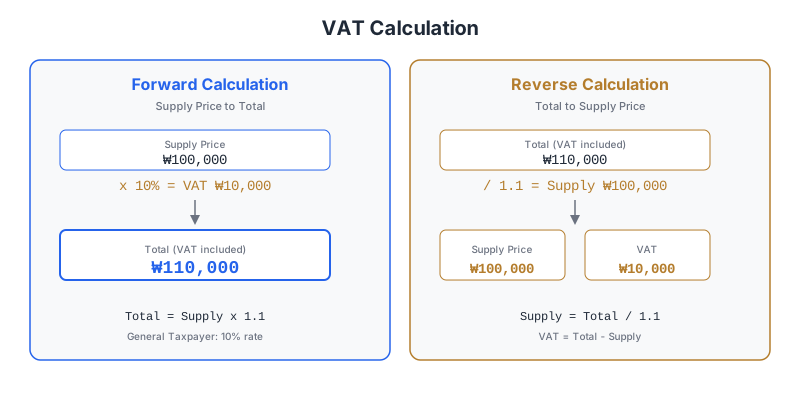
Total = Supply Value + VAT
Total = Supply Value + (Supply Value × 10%)
Total = Supply Value × 1.1
The Reverse-Calculation Formula
When you know the total amount (VAT included) and need to find the supply value and VAT:
Supply Value = Total ÷ 1.1
VAT = Total - Supply Value
Alternatively, you can calculate the VAT directly:
VAT = Total ÷ 11The logic is simple: since the total is 1.1 times the supply value, dividing by 1.1 recovers the original supply value. The VAT portion equals exactly 1/11 of the total.
Practical Calculation Examples
Example 1: Total of 1,100,000 KRW
Supply Value = 1,100,000 ÷ 1.1 = 1,000,000 KRW
VAT = 1,100,000 - 1,000,000 = 100,000 KRW
Verification: 1,000,000 × 10% = 100,000 (VAT) → 1,000,000 + 100,000 = 1,100,000 (Total) ✓
Example 2: Total of 3,300,000 KRW
Supply Value = 3,300,000 ÷ 1.1 = 3,000,000 KRW
VAT = 3,300,000 - 3,000,000 = 300,000 KRW
Example 3: Total of 2,750,000 KRW
Supply Value = 2,750,000 ÷ 1.1 = 2,500,000 KRW
VAT = 2,750,000 - 2,500,000 = 250,000 KRW
Example 4: Total of 1,234,567 KRW (handling remainders)
Supply Value = 1,234,567 ÷ 1.1 = 1,122,333.636...When the division does not produce a whole number, the standard practice is to truncate (round down) to the nearest won:
Supply Value = 1,122,333 KRW (truncated)
VAT = 1,234,567 - 1,122,333 = 112,234 KRW
Verification: 1,122,333 + 112,234 = 1,234,567 ✓
The rounding method can vary by agreement between parties, but the National Tax Service standard for tax invoices is truncation below the won.
Using Reverse Calculation for Tax Invoices
Tax Invoice Scenario
If you and a client agree on a contract for “5.5 million KRW total,” the tax invoice should read:
| Item | Amount |
|---|---|
| Supply value | 5,000,000 KRW |
| VAT | 500,000 KRW |
| Total | 5,500,000 KRW |
Calculation:
Supply Value = 5,500,000 ÷ 1.1 = 5,000,000 KRW
VAT = 5,500,000 - 5,000,000 = 500,000 KRW
Tax Invoices with Multiple Line Items
When you have a total amount covering multiple items, the principle is to reverse-calculate each item individually. In practice, however, it is common to reverse-calculate from the overall total. Be careful with rounding adjustments so that the sum of supply values plus the sum of VAT equals the stated total.
Common Mistakes to Avoid
Mistake 1: Multiplying the Total by 10%
The most frequent error is applying 10% directly to the total amount:
❌ Wrong: 1,100,000 × 10% = 110,000 KRW (VAT)
✅ Correct: 1,100,000 ÷ 11 = 100,000 KRW (VAT)
Multiplying the total by 10% overstates the VAT by 10%. The 10% rate applies to the supply value, not the total.
Mistake 2: Confusing VAT-Exempt Items
Not all transactions are subject to VAT. Basic necessities (unprocessed food, tap water), medical and education services, and books and newspapers are VAT-exempt. If you reverse-calculate VAT on a receipt that includes exempt items, the result will be incorrect.
Mistake 3: Using 10% for Simplified Taxpayer Transactions
Simplified taxpayers have effective tax rates of 1.5% to 4% depending on industry. Applying the standard 10% reverse calculation to a simplified taxpayer’s transaction produces the wrong result. However, simplified taxpayers with revenue of 48 million KRW or more do issue tax invoices showing VAT at the standard 10% rate.
Business Situations That Require Reverse Calculation
1. Preparing Quotations
When a client provides a budget as a “VAT-inclusive total,” you need to separate the supply value and VAT to prepare a proper quotation.
2. Expense Settlement
To claim input tax credits on purchases made with a corporate or business card, you need to isolate the VAT from the receipt total.
3. Inter-Company Settlements
After a transaction based on a total amount, you often need to split it into supply value and VAT to issue the corresponding tax invoice.
4. Price Comparisons
When comparing prices that are quoted both with and without VAT, reverse calculation lets you convert everything to a consistent basis for accurate comparison.
Quick VAT Calculation at utilo.kr
If pulling out a calculator or building spreadsheet formulas every time feels tedious, try the VAT calculator at utilo.kr/tax. Enter the supply value or total amount, and it instantly computes the VAT, showing you all three figures. It supports both forward and reverse calculations, making it a handy tool for daily business use.
Conclusion
Reverse-calculating VAT is conceptually simple, but real-world application requires attention to rounding rules, exempt-item distinctions, and taxpayer type differences. As long as you remember the core formula — Supply Value = Total ÷ 1.1 — you will handle the vast majority of situations correctly. Since this calculation comes up so frequently in business, bookmarking the utilo.kr VAT calculator is a practical time-saver.
Frequently Asked Questions
What's the difference between general and simplified taxpayers in Korea?
General taxpayers charge 10% VAT and can claim input VAT credits. Simplified taxpayers face lower industry-specific rates (0.5–3%) but have limited credit claims. From 2024, businesses with annual revenue under KRW 104M qualify for simplified status.
Is VAT ultimately borne by the consumer?
Yes. Businesses remit the difference between output and input VAT, but the economic burden passes to the final consumer — VAT is an indirect tax.
Zero-rated vs tax-exempt — what's the difference?
Zero-rated supplies (e.g., exports) are VAT-taxable at 0%, allowing input VAT credits. Tax-exempt supplies (certain essentials) are outside the VAT system, so no input VAT credit is available.